
Why is skin cancer on the rise among older adults?
Peer reviewed by Dr Krishna Vakharia, MRCGPAuthored by Lydia SmithOriginally published 24 Aug 2023
Meets Patient’s editorial guidelines
- DownloadDownload
- Share
- Language
- Discussion
- Audio Version
- Add to preferred sources on Google
The number of people in the UK being diagnosed with skin cancer has hit a record high, with 17,500 cases of melanoma recorded every year1. In particular, there has been a sharp rise in cases among adults over 55. But why is this - and how can you spot the early symptoms of skin cancer?
Rising rates of skin cancer
The rise in skin cancer rates amongst over-55s is a worrying trend that has been seen in dermatology clinics across the country, says Dr Derrick Phillips, a skin specialist (dermatologist) and British Skin Foundation spokesperson.
Some of this has been caused by the rise of cheap package holidays abroad, as people over-55 were the first generation to go on these. “This meant holiday sun was accessible to the masses at a time when there was a lack of effective sunscreen, and a lack of understanding of the harmful effects of UV exposure,” says Phillips.
“As a result, many in this group accumulated significant sun damage in their early years. We now know that UV exposure in childhood and adolescence is an important risk factor for non-melanoma skin cancers, such as squamous cell carcinoma and basal cell carcinomas, which develop decades later.”
Additionally, population growth and greater awareness of skin cancer may also have contributed to the increase, as people may be more likely to get their skin checked.
Sponsored
Concerned about a mole?
Get your mole checked by a specialist - Peace of mind within 24 hours
If you have a mole that changes, or if new ones appear, this in-app mole assessment helps identify the need for further investigation - all from the comfort of your home.

Older adults less likely to use sun protection
Applying sun protection - such as lotions and creams containing SPF - and covering up using hats and appropriate clothing are important. However, research suggests that older generations may be less likely to use suncream, especially when in the UK.
In one survey, 45% of people said they rarely used sunscreen during the summer in the UK, even in sunny weather2. A separate survey carried out in the US found that only around 15% of older adults regularly used sun protection3.
A misunderstanding of skin cancer risk may be the cause, as well as the belief that sun exposure later in life can lead to cancer. “However, melanoma - which can arise following short exposure to high intensity UV radiation - can develop over short time frames,” says Phillips.
Types of skin cancer
The three most common types of skin cancer are basal cell carcinoma, squamous cell carcinoma and melanoma.
Basal cell carcinomas are slow growing skin growths that are shiny when illuminated and often have prominent blood vessels on their surface. They have rolled edges and a central dip with a tendency to scab and may appear as a non-healing wound. Most basal cell carcinomas occur on the head and neck.
Squamous cell carcinomas are quick-growing, scaly skin growths. They can be tender to touch and may also ooze or bleed. Again, they can appear as non-healing wounds but they are scaly and feel rough to touch.
Melanoma is another form of skin cancer that develops from the pigment-producing cells in the skin. It can arise from new or existing moles or sunspots. These can be seen as a change to an existing mole (think ABCDE as below) or as a brand new one that just comes up.
What are the signs of skin cancer to look out for?
It’s important to monitor your skin throughout the year and to look for new or changing moles or skin growths. When checking moles or pigmented marks on the skin, the ABCDE tool can help you to decide if your mole may be a melanoma and you need to be seen by a specialist.
Asymmetry - is one half different from the other.
Border - are the edges unclear, jagged or have irregular borders.
Colours - is the mole two or more colours.
Diameter - is it larger than 6mm (around the size of the end of a pencil).
Evolving - has it changed in size, shape or colour. Is it itching or bleeding.
If you have any of these signs speak to your doctor
ABCDE melanoma
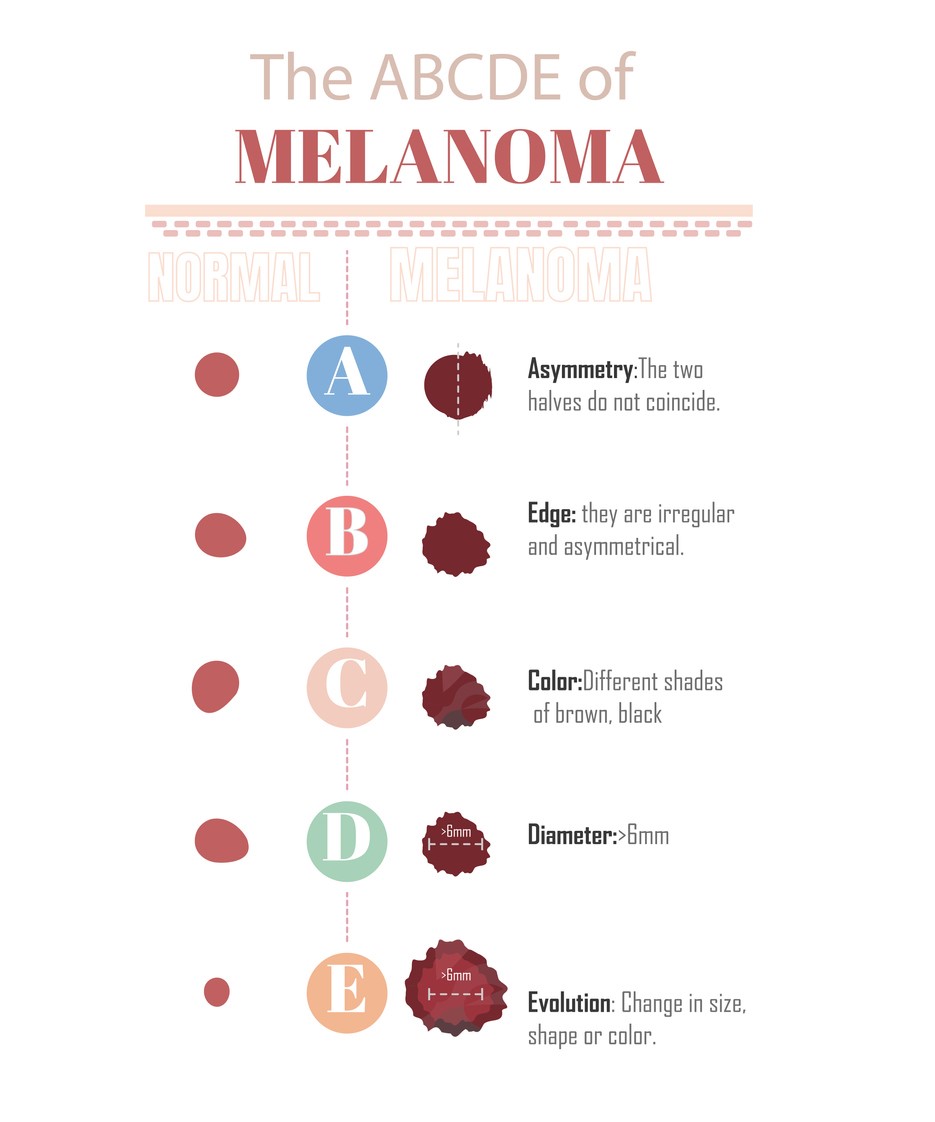
For most people it is ok to check your moles every two to three months,” says Phillips. “However, for those at higher risk of skin cancer, more frequent checks are needed.
It's important to check your whole body for moles to monitor any changes to them - including under your nail beds and on your feet.
The main risk factors for skin cancer include having:
Fair skin with freckles.
A history of multiple sunburn episodes with blistering.
More than 50 moles.
Atypical or unusual moles.
A personal or family history of skin cancer.
Certain genetic conditions.
Using medications that suppress the immune system.
If you are concerned about a mole or skin growth, you should see your GP. It’s always better to be safe and see a health professional if you are worried.
How to prevent skin cancer
Skin cancer isn’t always preventable, but you can reduce your chance of developing it by avoiding overexposure to UV light from sunlight.
You can help protect yourself by:
Using high-factor sunscreen such as a factor 50.
Covering up in the sun - sleeves, hat and sunglasses.
Never using sunbeds.
Regularly checking your skin for signs of skin cancer can help lead to an early diagnosis and increase your chance of successful treatment.
Further reading
Patient picks for Skin cancer

Cancer
What it's like to be diagnosed with skin cancer
With increased accessibility to exotic destinations and a rise in sunbed use, skin cancer rates are soaring. In fact, it's now the fifth most common cancer in the UK (and the second most common in young adults), killing over 2,500 people a year. We speak to Loti Jackson who was diagnosed with the disease at 27 and explore the skin cancer warning signs to look out for.
by Karen Gordon
Cancer
Your essential skin cancer checklist
Skin cancer can kill you, so it's essential to know the signs and get any suspicious skin changes checked out quickly. Here we show what to look for and what to do to try and prevent it happening.
by Victoria Raw
About the authorView full bio
Authored by

Lydia Smith
Feature writer
BA, MA, MSc
Lydia Smith is an award-winning journalist and feature writer who has written extensively on women's health and mental health. She is currently studying for an MSc in psychology.
About the reviewerView full bio

Dr Krishna Vakharia, MRCGP
Chief Medical Officer for Health, Optum UK
MBChB, MRCGP(2013), BMedSci (hons), DFSRH, DRCOG, PGDipDerm (Distn)
Dr Krishna Vakharia is an NHS GP. She is also a regular examiner for the postgraduate Diploma in Practical Dermatology at Cardiff University as well as being the Chief Medical Officer for health at Optum UK.
Article history
Article also available in English, German, Spanish, French, Italian, Portuguese, Hindi, Hebrew, Arabic, and Swedish.
24 Aug 2023 | Originally published
Authored by:
Lydia SmithPeer reviewed by
Dr Krishna Vakharia, MRCGP
Join the conversation
Share your thoughts or experiences with others in our patient communities.

Ask, share, connect.
Browse discussions, ask questions, and share experiences across hundreds of health topics.

Feeling unwell?
Assess your symptoms online for free
Sign up to the Patient newsletter
Your weekly dose of clear, trustworthy health advice - written to help you feel informed, confident and in control.
By subscribing you accept our Privacy Policy. You can unsubscribe at any time. We never sell your data.