Spinal muscular atrophy with respiratory distress type 1
עודכן לאחרונה 18 Aug 2020
עומד בהנחיות העריכה של Patient
- הורדהורד
- שתף
- Language
- דיון
- גרסת שמע
- הוסף למקורות מועדפים בגוגל
Spinal muscular atrophy with respiratory distress type 1 (SMARD1) is an inherited condition that causes muscle weakness and respiratory failure typically beginning in infancy. Early features of this condition are difficult and noisy breathing, especially when inhaling; a weak cry; problems feeding; and recurrent episodes of pneumonia. Typically between the ages of 6 weeks and 6 months, infants with this condition will experience a sudden inability to breathe due to paralysis of the muscle that separates the abdomen from the chest cavity (the diaphragm). Normally, the diaphragm contracts and moves downward during inhalation to allow the lungs to expand. With diaphragm paralysis, affected individuals require life-long support with a machine to help them breathe (mechanical ventilation). Rarely, children with SMARD1 develop signs or symptoms of the disorder later in childhood.
תיאור
Spinal muscular atrophy with respiratory distress type 1 (SMARD1) is an inherited condition that causes muscle weakness and respiratory failure typically beginning in infancy. Early features of this condition are difficult and noisy breathing, especially when inhaling; a weak cry; problems feeding; and recurrent episodes of pneumonia. Typically between the ages of 6 weeks and 6 months, infants with this condition will experience a sudden inability to breathe due to paralysis of the muscle that separates the abdomen from the chest cavity (the diaphragm). Normally, the diaphragm contracts and moves downward during inhalation to allow the lungs to expand. With diaphragm paralysis, affected individuals require life-long support with a machine to help them breathe (mechanical ventilation). Rarely, children with SMARD1 develop signs or symptoms of the disorder later in childhood.
Soon after respiratory failure occurs, individuals with SMARD1 develop muscle weakness in their distal muscles. These are the muscles farther from the center of the body, such as muscles in the hands and feet. The weakness soon spreads to all muscles; however, within 2 years, the muscle weakness typically stops getting worse. Some individuals may retain a low level of muscle function, while others lose all ability to move their muscles. Muscle weakness severely impairs motor development, such as sitting, standing, and walking. Some affected children develop an abnormal side-to-side and back-to-front curvature of the spine (scoliosis and kyphosis, often called kyphoscoliosis when they occur together). After approximately the first year of life, individuals with SMARD1 may lose their deep tendon reflexes, such as the reflex being tested when a doctor taps the knee with a hammer.
Other features of SMARD1 can include reduced pain sensitivity, excessive sweating (hyperhidrosis), loss of bladder and bowel control, and an irregular heartbeat (arrhythmia).
Inheritance patterns
The source lists the following possible inheritance patterns: Autosomal recessive. More than one pattern can apply in different cases.
Related genes
Other names
Autosomal recessive distal spinal muscular atrophy 1
DHMN6
Diaphragmatic spinal muscular atrophy
Distal hereditary motor neuronopathy type VI
Distal spinal muscular atrophy type 1
DSMA1
HMN6
HMNVI
Severe infantile axonal neuropathy with respiratory failure
SIANRF
SMARD1
Spinal muscular atrophy with respiratory distress
Related patient information and medicines

Patient information leaflet
כשל נשימתי
Pulmonary fibrosis . Asthma. Pneumothorax . Pulmonary embolism. Pulmonary hypertension (high blood pressure in the blood vessels that supply the lungs). Bronchiectasis. Acute respiratory distress syndrome (ARDS): a life-threatening condition in which the lungs are unable to provide enough oxygen. It usually occurs as a complication of a serious.

Patient information leaflet
דושן ניוון שרירים
דושן ניוון שרירים is a condition which causes progressive muscle weakness. It starts in childhood and may be noticed when a child has difficulty standing up, climbing or running. ניוון שרירים על שם דושן (DMD) מטופל? an inherited (genetic) condition which affects muscle strength and function. It causes progressive muscle weakness and is a.

Patient information leaflet
ניוון שרירים
ניוון שרירים הוא inherited (genetic) disorder causing muscle weakness. There are different types of muscular dystrophy, which vary as to how severe they are, ranging from very mild to severe. The different types also vary as to what age t... What is muscular dystrophy. Muscular dystrophy (MD) is the name given to a group of disorders which.

Patient information leaflet
בעיות בדיסק בעמוד השדרה
Spinal discs are also called intervertebral discs. There is a spinal disc between each bone (vertebra) in your spine. This keeps the vertebrae separated and acts as a shock absorber. As we get older the spinal discs gradually become damaged and this can cause problems such as back pain. Other problems affecting the spinal discs include a slipped.
Patient information leaflet
הרדמה ספינלית
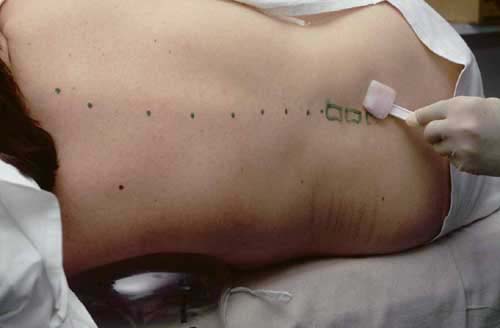
A spinal anaesthetic is an alternative to a general anaesthetic for some operations. What is a spinal anaesthetic. This is where the anaesthetist gives the patient medication, usually through a drip (cannula) into a vein, and sends them off to sleep. A breathing tube is inserted after the patient is asleep so the breathing can be controlled.

Patient information leaflet
סרטן הכליה
רוב cases of kidney cancer develop in people between the ages of 60 and 70 although it can affect any age group. If kidney cancer is diagnosed at an early stage, there is a good chance of a cure. A description of what kidneys are and how they work is at the bottom of this article. What is kidney cancer. There are several types of kidney cancer.
קריאה נוספת והפניות
- Spinal muscular atrophy with respiratory distress type 1; MedlinePlus, National Library of Medicine.
- Eckart M, Guenther UP, Idkowiak J, Varon R, Grolle B, Boffi P, Van Maldergem L, Hubner C, Schuelke M, von Au K. The natural course of infantile spinal muscular atrophy with respiratory distress type 1 (SMARD1). Pediatrics. 2012 Jan;129(1):e148-56. doi: 10.1542/peds.2011-0544. Epub 2011 Dec 12.
- Guenther UP, Handoko L, Varon R, Stephani U, Tsao CY, Mendell JR, Lutzkendorf S, Hubner C, von Au K, Jablonka S, Dittmar G, Heinemann U, Schuetz A, Schuelke M. Clinical variability in distal spinal muscular atrophy type 1 (DSMA1): determination of steady-state IGHMBP2 protein levels in five patients with infantile and juvenile disease. J Mol Med (Berl). 2009 Jan;87(1):31-41. doi: 10.1007/s00109-008-0402-7. Epub 2008 Sep 18.
- Guenther UP, Varon R, Schlicke M, Dutrannoy V, Volk A, Hubner C, von Au K, Schuelke M. Clinical and mutational profile in spinal muscular atrophy with respiratory distress (SMARD): defining novel phenotypes through hierarchical cluster analysis. Hum Mutat. 2007 Aug;28(8):808-15. doi: 10.1002/humu.20525.
- Kaindl AM, Guenther UP, Rudnik-Schoneborn S, Varon R, Zerres K, Schuelke M, Hubner C, von Au K. Spinal muscular atrophy with respiratory distress type 1 (SMARD1). J Child Neurol. 2008 Feb;23(2):199-204. doi: 10.1177/0883073807310989.
- van der Pol WL, Talim B, Pitt M, von Au K. 190 th ENMC international workshop: Spinal muscular atrophy with respiratory distress/distal spinal muscular atrophy type 1: 11-13 May 2012, Naarden, The Netherlands. Neuromuscul Disord. 2013 Jul;23(7):602-9. doi: 10.1016/j.nmd.2013.04.004. Epub 2013 May 29. No abstract available.
הצטרפו לשיחה
שתפו את מחשבותיכם או חוויותיכם עם אחרים ב קהילות המטופלים שלנו.

שאלו, שתפו, התחברו.
עיין בדיונים, שאל שאלות ושתף חוויות במאות נושאים בריאותיים.
הירשמו לניוזלטר של פיישנט
המנה השבועית שלך של עצות בריאות ברורות ואמינות - נכתבה כדי לעזור לך להרגיש מעודכן, בטוח ובשליטה.
על ידי הרשמה אתה מקבל את שלנו מדיניות הפרטיות שלנו. באפשרותך לבטל את המנוי בכל עת. לעולם לא נמכור את הנתונים שלך.