ורטיגו תנוחתי פרוקסיזמלי שפיר
נבדק על ידי Dr Doug McKechnie, MRCGPעודכן לאחרונה על ידי Dr Philippa Vincent, MRCGPעודכן לאחרונה 17 Dec 2024
עומד בהנחיות העריכה של Patient
- הורדהורד
- שתף
- Language
- דיון
- גרסת שמע
- הוסף למקורות מועדפים בגוגל
Benign paroxysmal positional vertigo usually causes short episodes of intense dizziness or vertigo when the head is moved in certain directions. Vertigo is the sensation that you (or your surroundings) are moving. This is often described as "the room spinning around".
Benign paroxysmal positional vertigo is thought to be caused by tiny solid fragments (otoconia) in the inner ear labyrinth. In most cases the condition gets better on its own after several weeks.
A simple treatment of moving the head into various positions over a few minutes can cure the condition in many cases. This treatment uses gravity to move the tiny fragments away from where they are causing problems.
במבט חטוף
ורטיגו פרוקסיזמלי תנוחתי שפיר (BPPV) הוא מצב באוזן הפנימית הגורם לסחרחורת פתאומית וחזקה.
התסמינים בדרך כלל מופעלים על ידי תנועות ראש מסוימות ונמשכים זמן קצר.
ה-BPPV נגרם על ידי חלקיקים זעירים בנוזל האוזן הפנימית.
מניפולציית אפלי יכולה לעיתים קרובות לטפל בהצלחה ב-BPPV.
See a doctor if vertigo is persistent, you have hearing loss or tinnitus, or symptoms affect your life.
What is benign paroxysmal positional vertigo?
Benign paroxysmal positional vertigo (BPPV) is a condition of the inner ear. It is a common cause of intense dizziness and ורטיגו, especially in older people.
Benign means that the cause is neither cancerous nor serious.
Paroxysmal means episodes of symptoms that come and go, often without warning.
Positional means that the symptoms are usually triggered by certain positions. In the case of BPPV, certain positions of the head typically trigger symptoms.
ורטיגו is a sensation of movement. If you have vertigo you feel as if the world is moving around you or that you are moving when you aren't. You feel very unsteady, a bit like being on a ship. Often you will also feel sick, although it is relatively uncommon to actually be sick (vomit).
Understanding the inner ear
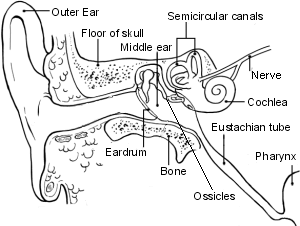
The inner ear includes the cochlea and semi-circular canals. These are small shell-like structures in which there is a system of narrow fluid-filled channels called the labyrinth. The semi-circular canals sense movement of the head and help to control balance and posture. The cochlea is the part of the inner ear that is responsible for hearing.
Cross-section of the ear
Inner ear diagram
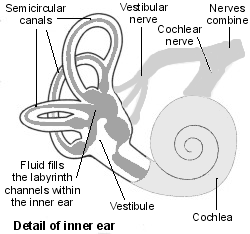
There are three semi-circular canals (anterior - 'front', lateral - 'side' and posterior - 'back'). These are roughly at right angles to each other and sense movement in different directions. The three semi-circular canals are connected to a larger fluid-filled chamber called the vestibule, which in turn is connected to the fluid-filled canal in the cochlea.
When the head is moved, the fluid in the labyrinth within the semi-circular canals moves too. The movement of the fluid moves tiny fine hairs that are on the inside lining of the labyrinth. When the hairs move, this triggers nerve messages to be sent to the brain via a nerve called the vestibular nerve. This gives the brain information about the movement and position of the head, even when your eyes are closed.
Three things are required to help balance and maintenance of good posture:
a labyrinth in each ear
ראייה
nerve messages from the joints and muscles of the body.
Signals from these three systems provide information to the brain in order to help with balance.
What happens in benign paroxysmal positional vertigo?
Benign paroxysmal positional vertigo is caused by one or more tiny solid fragments (otoconia) that float about in the fluid of the labyrinth. The fragments are made up of calcium carbonate crystals which are thought to have broken off from the inside lining of the vestibule part of the labyrinth. These cause no problems if the fragment remains in the vestibule. However, problems occur if a fragment gets into one of the semi-circular canals.
Debris for removal
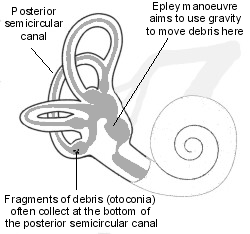
The posterior canal is the one that is affected 8 or 9 times out of 10. In this situation, when the head is still, the fragment sits at the bottom of the posterior canal. But when the head moves in certain directions the fragment gets carried along with the flow of fluid.
The fragment brushes along the delicate hairs that line the semi-circular canal and this bombards messages down the vestibular nerve. The extra nerve messages sent from the affected ear conflict with the normal messages sent from the other unaffected ear and from the eyes and the rest of the body. The brain becomes very confused and reacts with vertigo.
It is not clear why these otoconia form or drop off from the inside lining of the labyrinth. Most cases of benign paroxysmal positional vertigo occur in people over the age of 40 years. Age-related BPPV is one of the most common causes of vertigo in older people.
However, some younger people develop BPPV following an injury to the head, or following a previous infection in the inner ear. Sometimes it occurs for no apparent reason.
Symptoms of benign paroxysmal positional vertigo
The main symptom of benign paroxysmal positional vertigo is vertigo itself. The vertigo lasts just a short time - typically just for 20-30 seconds and usually no longer than a minute. It goes away completely if the head is kept still. The vertigo is usually triggered by a change in head position.
Getting out of bed and rolling over in bed are two of the most common movements that trigger a short episode of vertigo. Sometimes looking up triggers an episode of vertigo.
Each episode of vertigo may cause a feeling of nausea but people rarely vomit. The בחילה may last an hour or so even though the vertigo lasts just seconds. Between episodes of benign paroxysmal positional vertigo people feel well. Many people who develop benign paroxysmal positional vertigo realise which head movements trigger their symptoms and so instinctively avoid those movements.
In most cases, the symptoms clear away within a few weeks or months. The solid fragments (otoconia) may dissolve or float out from the posterior semi-circular canal and lodge in the vestibule where they cause no symptoms.
However some people have recurrences of symptoms months or years later. In some cases, symptoms persist for years.
מתי לפנות לרופא
It is important to seek medical advice if:
The vertigo is persistent and does not come and go.
There is an associated hearing loss that develops alongside the vertigo.
There are symptoms of tinnitus (ringing in the ear) that develop alongside the vertigo.
The symptoms are frequent or troubling enough to impact on lifestyle.
Diagnosing benign paroxysmal positional vertigo
The symptoms of benign paroxysmal positional vertigo are quite characteristic and so a doctor may well suspect this condition just from the symptoms.
To confirm the diagnosis, sometimes a test called the Dix-Hallpike manoeuvre is performed. This starts with sitting on a doctor's couch and then lying back and moving the head in certain directions. These set movements in people with BPPV will usually trigger an episode of vertigo.
What else might it be?
Other possible causes of vertigo include vestibular migraine, vestibular neuritis or labyrinthitis ו מחלת מנייר. However, these conditions tend to cause vertigo that lasts longer than in the case of benign paroxysmal positional vertigo.
Treatment for benign paroxysmal positional vertigo
The Epley manoeuvre
This is a simple cure that might be tried by a clinician but can also be done at home. This often works if there are fragments of debris at the bottom of the posterior semi-circular canal (the most common situation). This is done by a series of four movements of the head. After each movement, the head is held in the same place for 30 seconds or so.
The movements of the head cause the posterior semi-circular canal to rotate around in such a way that gravity moves the otoconia fragments out from the posterior canal and into the vestibule where they then settle and cause no symptoms.
Studies report that the Epley manoeuvre is successful in stopping symptoms in about 8 in 10 cases with just one treatment. If the first treatment does not work, there is still a good chance that it will work in a repeated treatment session a week or so later.
The Epley manoeuvre is one of the few procedures that can be done in a few minutes to completely cure symptoms. If symptoms return at a later date, the manoeuvre can be repeated.
The Semont manoeuvre
The Semont is an alternative to the Epley manoeuvre. It is also used to treat benign paroxysmal positional vertigo affecting the posterior semi-circular canal. The Semont involves moving the patient quickly from lying on one side to lying on the other. This manoeuvre may be more suitable than the Epley for those with neck stiffness.
Brandt-Daroff exercises
These can easily be done at home. They can provoke dizziness in the short term but often lead to longer term relief. A leaflet explaining them is in the further reading section below.
ללא טיפול
Benign paroxysmal positional vertigo is a condition that can go away on its own after several weeks or months without any treatment. The otoconia are thought either to dissolve or move to a place in the labyrinth where they cause no symptoms.
הפניה
If benign paroxysmal positional vertigo has been diagnosed but is not settling (either by itself or with repositioning manoeuvres), either the lateral or anterior semicircular canal may be affected (rather than the more common posterior canal).
Benign paroxysmal positional vertigo affecting the lateral or anterior canals can be harder to treat and alternative manoeuvres are needed. A referral to an ENT surgeon for review and treatment in such cases. A referral may also be required if the cause of the vertigo is unclear.
ניתוח
Treating benign paroxysmal positional vertigo with surgery is extremely rare as, in most cases, the condition either improves by itself or can be cured by a repositioning manoeuvre. If symptoms persist for months or years and cannot be eased, an operation of the inner ear to take out the function of the affected semicircular canal may be an option. An ear specialist will advise.
How do I keep safe while I have benign paroxysmal positional vertigo?
The DVLA states that you should stop driving if you have sudden, unexpected and disabling attacks of dizziness: Dizziness or vertigo and driving - GOV.UK (www.gov.uk).
You should inform your employer if BPPV could pose a risk to yourself or others in your job. For example, if you use ladders, operate heavy machinery, or drive.
To avoid falls around the home, get out of bed slowly and avoid jobs around the house that involve looking upwards if possible.
בחירות המטופלים עבור סחרחורת

סימנים ותסמינים
התעלפות
Fainting is a temporary loss of consciousness that happens when the brain does not receive enough oxygen because of reduced blood flow to the brain. It comes on suddenly, only lasts for a short time and you recover fully within a short time. It is also often called a blackout. The medical term is syncope. It isn't the same thing as a seizure which usually causes jerking. It is important to seek medical attention if you experience faints. Faints may be caused by a serious problem. However, this is unusual. The most common causes are mentioned below.
מאת ד"ר קולין טיידי, MRCGP

סימנים ותסמינים
ורטיגו
Vertigo is the sensation that you, or the world around you, is moving or spinning. Vertigo is a symptom, rather than a diagnosis. You may only experience vertigo for a short period of time (seconds or minutes). However, for some people, vertigo can last many hours. People who have vertigo may also feel sick (nausea) or may vomit. They can also feel unsteady or dizzy. Vertigo can be caused by problems within the inner ear or the brain. Some medications can be used to reduce the vertigo symptoms and also ease associated nausea and vomiting. These medicines are not needed for every cause of vertigo and are usually only given for a short period (usually used for just 3-4 days at a time). In many cases your doctor will identify what condition has caused the vertigo and can then recommend specific treatment for that condition.
מאת ד"ר סורנגי מנדיס, MRCGP
שאלות נפוצות
האם אני יכול לבצע את תמרון אפלי בעצמי בבית?
תמרון אפלי הוא טיפול פשוט שניתן לנסות על ידי קלינאי אך גם ניתן לבצע בבית. הוא כולל סדרה של ארבע תנועות ראש ספציפיות, כאשר כל תנוחה מוחזקת למשך כ-30 שניות. המטרה היא להשתמש בכוח הכבידה כדי להזיז את השברים מתוך התעלה החצי-מעגלית חזרה אל הווסטיבול, שם הם לא יגרמו לתסמינים.
מה עליי לעשות אם תמרון אפלי לא עובד עבורי?
אם תמרון אפלי אינו מצליח, ניתן לחזור עליו בעוד כשבוע, ויש סיכוי טוב שהוא יעבוד אז. אם תמרוני מיקום מחדש, כולל אפלי, אינם עוזרים, או אם ה-BPPV שלך לא מתייצב, ייתכן שזה נובע מהשפעה על התעלות החצי-מעגליות הצדדיות או הקדמיות ולא האחוריות. במקרים כאלה, ייתכן שיהיה צורך בהפניה למנתח אף אוזן גרון לתמרונים חלופיים או אם סיבת הסחרחורת אינה ברורה.
האם יש טיפולים אחרים אם תמרון אפלי אינו מתאים?
כן, אם תמרון אפלי אינו מתאים, אפשרות נוספת היא תמרון סמונט. זה כולל העברה מהירה של המטופל משכיבה על צד אחד לשכיבה על הצד השני ויכול להיות טוב יותר לאנשים עם נוקשות בצוואר. בנוסף, ניתן לבצע תרגילי ברנדט-דרוף בבית, למרות שהם עשויים לגרום לסחרחורת זמנית, הם לרוב מובילים להקלה לטווח ארוך.
אילו מצבים נוספים עשויים לגרום לסחרחורת הדומה ל-BPPV אך נמשכת זמן רב יותר?
מצבים נוספים שיכולים לגרום לסחרחורת כוללים מיגרנה וסטיבולרית, נויריטיס וסטיבולרי או לבירינתיטיס, ומחלת מנייר. עם זאת, מצבים אלו בדרך כלל גורמים לסחרחורת שנמשכת זמן רב יותר מהסחרחורת הקצרה והאפיזודית הנראית בסחרחורת תנוחתית פרוקסיזמלית שפירה.
איך אני יכול להפוך את הבית שלי לבטוח יותר אם יש לי BPPV?
כדי להפחית את הסיכון לנפילות בבית, מומלץ לקום מהמיטה באיטיות. כדאי גם לנסות להימנע ממשימות ביתיות שדורשות להסתכל כלפי מעלה, אם אפשר, שכן תנועות ראש מסוימות יכולות לגרום לפרקים של סחרחורת.
קריאה נוספת והפניות
- Glasziou P, Bennett J, Greenberg P, et al; The Epley manoeuvre - for benign paroxysmal positional vertigo. Aust Fam Physician. 2013 Jan-Feb;42(1-2):36-7.
- Dommaraju S, Perera E; An approach to vertigo in general practice. Aust Fam Physician. 2016 Apr;45(4):190-4.
- ורטיגו תנוחתי פרוקסיזמלי שפיר; NICE CKS, April 2022
- Kim HJ, Park J, Kim JS; Update on benign paroxysmal positional vertigo. J Neurol. 2021 May;268(5):1995-2000. doi: 10.1007/s00415-020-10314-7. Epub 2020 Nov 24.
- You P, Instrum R, Parnes L; Benign paroxysmal positional vertigo. Laryngoscope Investig Otolaryngol. 2018 Dec 14;4(1):116-123. doi: 10.1002/lio2.230. eCollection 2019 Feb.
- Sinsamutpadung C, Kulthaveesup A; Comparison of outcomes of the Epley and Semont maneuvers in posterior canal BPPV: A randomized controlled trial. Laryngoscope Investig Otolaryngol. 2021 Jul 13;6(4):866-871. doi: 10.1002/lio2.619. eCollection 2021 Aug.
- Turner H, Lavender C, Rea P; Sudden-onset dizziness and vertigo symptoms: assessment and management of vestibular causes. Br J Gen Pract. 2020 May 28;70(695):310-311. doi: 10.3399/bjgp20X710369. Print 2020 Jun.
- Brandt-Daroff Exercises; Sandwell and West Birmingham NHS Trust
אודות המחברצפה בפרופיל המלא

Dr Philippa Vincent, MRCGP
רופא כללי, מחבר רפואי
MB BS, Bsc, MRCGP (2000), DCH, DFSRH, DRCOG
ד"ר Philippa וינסנט הוא רופא משפחה ב-NHS העובד בצפון לונדון.
אודות המבקרצפה בפרופיל המלא

Dr Doug McKechnie, MRCGP
כותב רפואי
MA, MBBS, MSc, DRCOG, MRCP(UK), MRCGP(2021), FHEA
ד"ר דאג מקקני הוא רופא משפחה ב-NHS העובד בלונדון. הוא עובד במשרה מלאה קלינית ומשמש גם כסגן ראש המודול לפרקטיקה קלינית ומקצועית בבית הספר לרפואה של יוניברסיטי קולג' לונדון.
היסטוריית המאמר
המידע בעמוד זה נכתב ונבדק על ידי קלינאים מוסמכים.
המאמר זמין גם ב אנגלית, גרמנית, ספרדית, צרפתית, איטלקית, פורטוגזית, הינדי, עברית, ערבית, and שוודית.
הסקירה הבאה מתוכננת ל: 16 דצמבר 2027
17 Dec 2024 | הגרסה האחרונה

שאלו, שתפו, התחברו.
עיין בדיונים, שאל שאלות ושתף חוויות במאות נושאים בריאותיים.

מרגיש לא טוב?
הערך את הסימפטומים שלך באינטרנט בחינם
הירשמו לניוזלטר של פיישנט
המנה השבועית שלך של עצות בריאות ברורות ואמינות - נכתבה כדי לעזור לך להרגיש מעודכן, בטוח ובשליטה.
על ידי הרשמה אתה מקבל את שלנו מדיניות הפרטיות שלנו. באפשרותך לבטל את המנוי בכל עת. לעולם לא נמכור את הנתונים שלך.