וסת ובעיות וסת
נבדק על ידי Dr Toni Hazell, FRCGPעודכן לאחרונה על ידי ד"ר היילי וילאסי, FRCGP עודכן לאחרונה 13 Feb 2023
עומד בהנחיות העריכה של Patient
- הורדהורד
- שתף
- Language
- דיון
- גרסת שמע
- הוסף למקורות מועדפים בגוגל
התחלת המחזור היא חלק מהתבגרות. המחזור מתחיל להתרחש בערך באותו זמן שבו מתרחשים שינויים אחרים בגוף, כמו התחלת התפתחות השדיים או צמיחת שיער ערווה. הגיל הממוצע להתחלת המחזור הוא 13, אך זה נורמלי להתחיל בכל זמן בין הגילאים 9 ל-15. מספר קטן של בנות עשויות להתחיל לפני או אחרי זה. המחזור נמשך עד גיל המעבר, שבדרך כלל מתרחש סביב גיל 50.
Note: for the purposes of this patient information leaflet, 'girls, females or women' are those individuals who are assigned to be female at birth. It is not intended to exclude or dismiss individuals who do not identify as female.
במבט חטוף
A period is the monthly shedding of the womb lining, resulting in vaginal bleeding.
A normal period involves 20-60 ml of blood loss and can last up to eight days.
Period pain, usually in the lower tummy and pelvis, is common and normal.
Options for absorbing blood include sanitary towels, tampons, menstrual cups, and period pants.
While unlikely, it is possible to get pregnant if you have sex during your period.
You should see a doctor if your period pattern changes, if bleeding occurs between periods, or after sex or menopause.
What are the different types of period problems?
What is a period?
For several days each month there is blood loss from the vagina. The amount of blood loss varies from period to period, and between women. The nature of the blood loss may also vary with some women having a dark scanty loss, and others having a heavier loss which is a brighter red. Sometimes clots are passed, especially if the loss is heavy. Sometimes there are small flaky fragments in with the menstrual blood. A normal amount of blood loss during each period is between 20 and 60 ml. (This is about 4 to 12 teaspoonfuls.) Bleeding can last up to eight days but five days is the average. The bleeding is usually heaviest on the first two days. Some pain in the lower tummy (abdomen) and pelvic pain - period pain - is common and normal.
Sanitary towels or tampons?
When you have a period, you will need to use something to absorb the blood you lose. It is common to use sanitary towels when periods first start. These are placed in your underwear to soak up the blood. They come in different sizes and styles. You may need a pad which is bigger or bulkier at night, or on the heavy days of your period. When it is light, a small panty liner may be enough.
Tampons, which you insert into your vagina to absorb the blood, can be more convenient. They need to be changed regularly. You can start to use tampons at any age after you start having periods. They may feel uncomfortable to start with and may take a little bit of practice to get used to. There are different sizes, so start with the smallest to get used to it. You may need to use several sizes of tampon during a period, depending on how heavy the bleeding is. A larger size may be needed in the early heavy stages, then a smaller one when bleeding becomes lighter. Some tampons come with an applicator. Other types are put in with your fingers. Some women prefer one type, others another. You will find the one which is easiest for you.
Sometimes you may like to mix and match - for example, using tampons for swimming but pads at other times. For very heavy periods you may even need to use both together.
An alternative to towels and tampons is a menstrual cup. This is a reusable device, about two inches long which is made from soft medical-grade silicone. It is placed in the vagina. The cup collects menstrual blood. It is folded and inserted into the vagina, then removed. It can be rinsed and reinserted up to every eight hours.
Another alternative is re-usable period pants. They are designed to avoid leakages and be more comfortable than towels or tampons.
See the separate article called Supporting your child when they start menstruation for more details.
Can you get pregnant during your period?
Although unlikely, it is possible to get pregnant by having sex during your period. Sperm can stay alive inside you for up to five days. So if you ovulate early and have a short menstrual cycle (see below) then it is possible for you to become pregnant. See below for more information about ovulation and the menstrual cycle.
Do I have to avoid anything when I have a period?
No. Carry on as normal. If you find the periods painful, regular exercise sometimes helps. Periods are not dirty; they are a normal part of a woman's life. You can go swimming, have a bath, etc. You may prefer to use tampons if you enjoy swimming.
What is the menstrual cycle?
Small organs called ovaries lie in the lower part of their tummy (abdomen). The ovaries lie either side of the womb (uterus). The ovaries start to produce female hormones around puberty which cause changes to the uterine lining. Every month during your period the lining of your womb is shed together with some blood.
Female reproductive organs (periods)
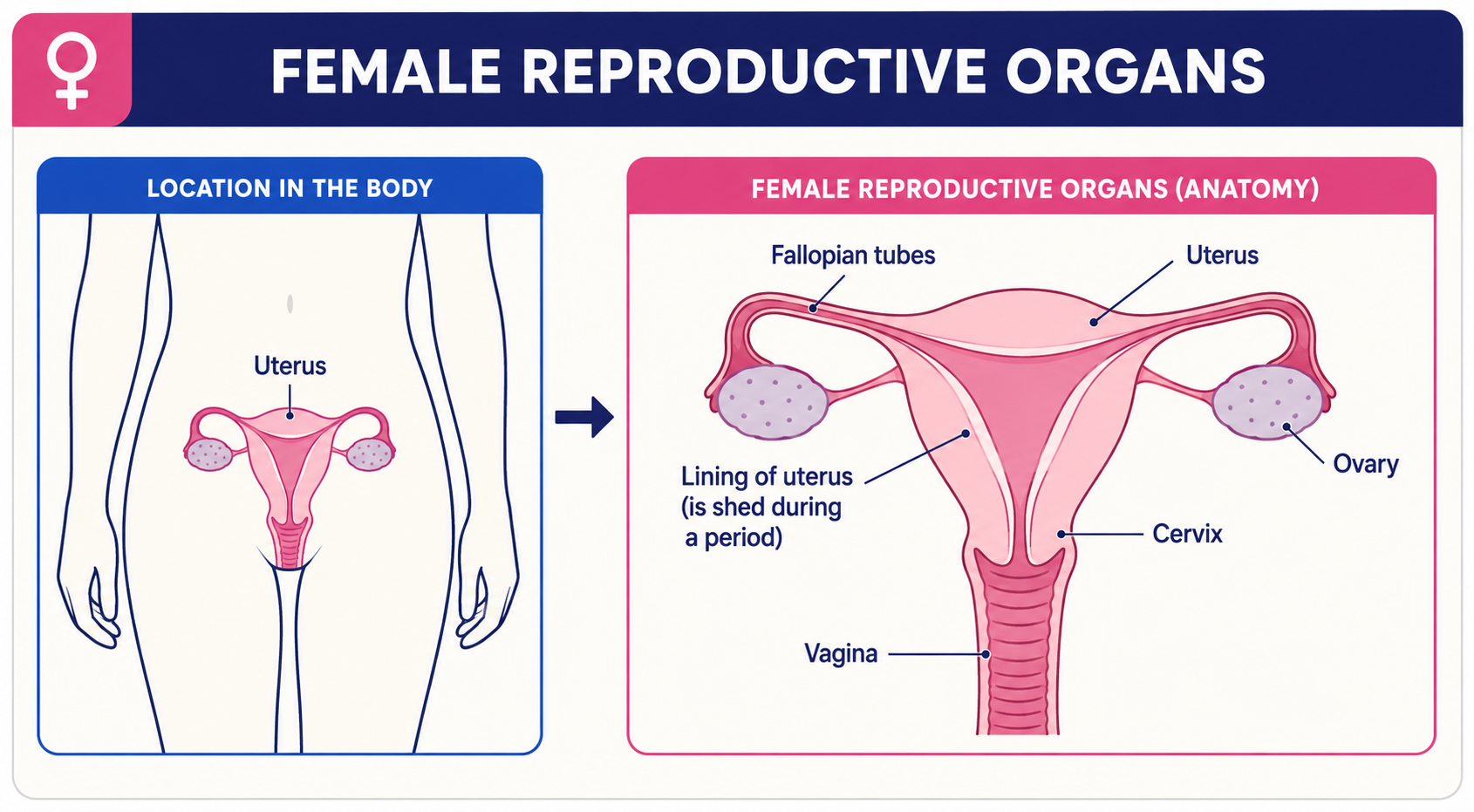
How long does a menstrual period last?
The time between the start of one period and the start of the next is called the menstrual cycle. The average length of a menstrual cycle is 28 days. However, anything between 24 and 35 days is common. During the cycle various changes occur in your body. The changes are controlled by chemical substances called hormones, which act like messengers in your body. There are changing amounts of your female hormones at different times of your cycle. The menstrual cycle is split roughly into two halves:
The first half of your cycle is called the follicular or proliferative phase. The levels of two main hormones, oestrogen and progesterone, are low to start with and you shed the inner lining of your womb (endometrium). This causes your period (menstrual bleeding).
During this phase your ovaries are stimulated by other hormones. These travel to the ovary in the bloodstream from a gland near your brain, called the pituitary gland. One of these hormones causes some eggs in your ovaries to grow and develop in tiny fluid-filled cavities called follicles. The follicles produce oestrogen. Throughout the first half of your cycle the level of oestrogen in your blood rises. One function of oestrogen is to cause the lining of your womb to thicken (proliferate).
Ovulation occurs about halfway through your cycle (about 14 days after the start of your period). Ovulation is the release of an egg into your Fallopian tube from a follicle in an ovary. The egg travels along your Fallopian tube into your womb. The egg may be fertilised if you have recently had sex and there are sperm in your womb.
The second half of the cycle is called the secretory or luteal phase. After ovulation, the follicle that released the egg makes a hormone called progesterone as well as oestrogen. Progesterone causes the lining of the uterus to swell and be ready to receive a fertilised egg. If the egg is not fertilised, the levels of progesterone and oestrogen gradually fall. When they fall to a low level, they lose their effect on your womb. The lining of your womb is then shed (a period) and a new cycle then begins.
Some symptoms relating to periods
In general, if you have a change from your usual pattern that lasts for several periods, it may be abnormal. You should contact a doctor if this occurs.
Heavy periods (menorrhagia)
וסת כבדה are very common. It is difficult to measure blood loss accurately. Periods are considered heavy if they are affecting your life and causing problems.
Painful periods (dysmenorrhoea)
Painful periods are common and you may experience an ache in your lower abdomen, back and tops of your legs, especially in the first few days of your period. The first two days are usually the worst. Some women have more pain than others. The cause of the pain is often not fully understood. Sometimes conditions such as endometriosis can make period pains become worse.
Bleeding at abnormal times
If you have vaginal bleeding at times apart from your expected periods, you should see a doctor. This includes if bleeding occurs after you have sex, or after the גיל המעבר. Bleeding after sex is also called postcoital bleeding.
Bleeding in between your periods (intermenstrual bleeding) can also occur. This has several causes. They include infections or polyps. Polyps are small fleshy lumps that can occur on the neck of the womb or inside the cavity of the womb. There are various causes of bleeding between periods:
One common cause is called breakthrough bleeding, which is small bleeds that occur in the first few months after starting the birth control pill. This usually settles over a few months.
It may be because the neck of the womb (cervix) is sore and inflamed. This can make it more likely to bleed after sex. The most common reasons for this are infections - such as כלמידיה - and hormonal changes.
It is very important to see your doctor because abnormal vaginal bleeding can be caused by cancer - for example, cancer of the צוואר הרחם או cancer of the womb.
Periods which stop (amenorrhoea) or are irregular
Periods may stop or become irregular. Pregnancy is the most common reason for periods to stop. However, it is not uncommon to miss the odd period for no apparent reason. Apart from pregnancy, other causes of periods stopping include stress, eating disorders, losing weight, exercising too much and hormonal imbalance. Blood tests can help diagnose the cause of the irregular bleeding.
The interval between periods can also vary between women. Irregular periods may indicate that you do not ovulate every month. Irregular periods are common in the few years leading up to the menopause.
בחירות המטופלים עבור וסת ובעיות וסת
בריאות האישה
מחזור חודשי שהוחמץ
החמצת מחזור יכולה לקרות מסיבות רבות. רוב הזמן אין סיבה לדאגה. כל עוד את בטוחה שאינך בהריון ואת מרגישה טוב בעצמך, אין צורך לדאוג אם את מחמיצה מחזור אחד או שניים. אם אין לך מחזור במשך 3-6 חודשים, או אם יש לך תסמינים אחרים, עליך להתייעץ עם רופא. לפעמים המחזור אצל נערות מתבגרות מתחיל מאוחר יותר מאשר אצל אחרות. אם המחזור שלך לא התחיל עד גיל 16 (או 14 אם לא התחלת להתפתח בדרכים אחרות כמו צמיחת שיער ערווה ושדיים) אז פני לרופא שלך. המחזור יכול להיות גם לא תדיר, לא סדיר או לא יציב. אם את מדממת בין המחזורים שלך או אחרי קיום יחסי מין, או אחרי גיל המעבר, עליך לדון בכך עם הרופא שלך.
מאת ד"ר רוזלין אדלמן, MRCGP

בריאות האישה
וסת כבדה
Heavy periods are common. In most cases no cause can be found. In some cases a cause is found - these can include endometriosis, fibroids and other conditions. There are a number of ways of improving heavy periods and making them more manageable. Options include medication to reduce bleeding, use of an intra-uterine system (sometimes known as a hormonal coil) or an operation.
מאת ד"ר פיליפה וינסנט, MRCGP
שאלות נפוצות
What is the lower abdomen and pelvic area?
The lower abdomen refers to the lower part of your tummy, and the pelvic area is located in the same general region. These are the areas where period pain commonly occurs, often described as an ache.
When might I consider using a menstrual cup instead of pads or tampons?
A menstrual cup is a reusable option for absorbing menstrual blood. It's made from soft, medical-grade silicone and is inserted into the vagina, similar to a tampon. It collects blood and can be rinsed and reinserted, lasting up to eight hours. Some women prefer it as an alternative to single-use pads or tampons.
What are reusable period pants?
Reusable period pants are an alternative to traditional sanitary products like towels and tampons. They are designed to prevent leakages and offer more comfort. You wear them like regular underwear, and they absorb menstrual blood.
What is postcoital bleeding?
Postcoital bleeding refers to vaginal bleeding that occurs after you have sex. If you experience this, it is important to see a doctor.
What is intermenstrual bleeding?
Intermenstrual bleeding is any bleeding that occurs between your expected periods. This can have several causes, including infections, polyps, or breakthrough bleeding if you've recently started birth control pills. It's important to see a doctor if you experience this type of bleeding.
קריאה נוספת והפניות
- Management of Premenstrual Syndrome; הקולג' המלכותי למיילדות וגינקולוגיה (2016)
- דימום וסת כבד: הערכה וניהול; הנחיות NICE (מרץ 2018 - עודכן מאי 2021)
- דיסמנוריאה; NICE CKS, אוקטובר 2023 (גישה בבריטניה בלבד)
- אמנוריאה; NICE CKS, February 2024 (UK access only)
אודות המחברצפה בפרופיל המלא

Dr Hayley Willacy, FRCGP
רופא כללי, מחבר רפואי
MBChB (1992), DRCOG, DFFP, MRCOG (Part 1) MRCGP (2007), DFSRH (2013), MSc - medical education (2020)
ד"ר היילי וילאסי הייתה רופאה כללית ב-NHS שעבדה בצפון מערב אנגליה, ופרשה מעבודתה הקלינית בשנת 2022 לאחר 30 שנות עבודה.
אודות המבקרצפה בפרופיל המלא

Dr Toni Hazell, FRCGP
MBBS, BSc, FRCGP, DFSRH, Dip GU med, DRCOG, DCH (London, UK, 2000)
ד"ר טוני הייזל סיימה את לימודיה בבית הספר לרפואה של בית החולים סנט מרי ועשתה את התמחותה בבית החולים נורת'וויק פארק.
היסטוריית המאמר
המידע בעמוד זה נכתב ונבדק על ידי קלינאים מוסמכים.
המאמר זמין גם ב אנגלית, גרמנית, ספרדית, צרפתית, איטלקית, פורטוגזית, הינדי, עברית, ערבית, and שוודית.
Next review due: 12 Feb 2028
13 Feb 2023 | הגרסה האחרונה

שאלו, שתפו, התחברו.
עיין בדיונים, שאל שאלות ושתף חוויות במאות נושאים בריאותיים.

מרגיש לא טוב?
הערך את הסימפטומים שלך באינטרנט בחינם
הירשמו לניוזלטר של פיישנט
המנה השבועית שלך של עצות בריאות ברורות ואמינות - נכתבה כדי לעזור לך להרגיש מעודכן, בטוח ובשליטה.
על ידי הרשמה אתה מקבל את שלנו מדיניות הפרטיות שלנו. באפשרותך לבטל את המנוי בכל עת. לעולם לא נמכור את הנתונים שלך.
עוד בבריאות נשים
- סרטן צוואר הרחם
- בדיקת צוואר הרחם
- אמצעי מניעה לנשים מעל גיל 40
- שיטות מניעה
- תזונה ואורח חיים במהלך ההריון
- ביופסיה של רירית הרחם
- עיקור נשים
- תסמונת אנטי-פרכוס עוברית
- שרירנים
- סולם גרין למנופאוזה
- ציסטיטיס אינטרסטיציאלי
- ממוגרפיה
- מחלת דלקת האגן
- כאב באגן אצל נשים
- תסמונת השחלות הפוליציסטיות
- דיכאון לאחר לידה
- אנדומטריטיס לאחר לידה
- פסיכוזה לאחר לידה
- ספינה ביפידה
- הגלולה המשולבת למניעת הריון (COC)