מחלת בירגר
נבדק על ידי ד"ר אדריאן בונסול, MBBSעודכן לאחרונה על ידי Dr Laurence Knottעודכן לאחרונה 25 Aug 2016
עומד בהנחיות העריכה של Patient
- הורדהורד
- שתף
- Language
- דיון
- Ask Patient
- גרסת שמע
- הוסף למקורות מועדפים בגוגל
הודעה לגבי התוכן
הדף הזה לא נבדק לאחרונה, ולכן ייתכן שחלק מהמידע או מהקישורים החיצוניים השתנו.
מחלת בירגר causes inflammation of blood vessels in the legs and arms, particularly in the hands and feet. It leads to narrowing and blockage of the blood vessels so that blood flow to the hands and feet is reduced. This causes pain and other symptoms. It may eventually lead to damage and death of the tissues in the hands and/or feet.
The exact cause is not known. It mainly affects smokers but occasionally occurs in non-smokers. The single most important thing that you can do if you are diagnosed with Buerger's disease is to stop smoking. This can help to stop the disease from becoming worse and reduces your chance of needing surgical removal (amputation) of a finger, a toe, or worse.
במבט חטוף
Buerger's disease causes inflammation and narrowing of blood vessels in the hands and feet.
Symptoms include pain, coldness, numbness, and colour changes in the affected limbs.
The condition is strongly linked to smoking and mainly affects younger men.
Stopping smoking is the most important and effective treatment for Buerger's disease.
Continued smoking can lead to ulcers, gangrene, and amputation.
Protect your hands and feet from cold and injury.
Get support to stop smoking
קבלו ייעוץ רפואי מקצועי בנוחות של ביתכם. השלימו ייעוץ מקוון קצר, הזמין 24/7, ובקשתכם תיבדק על ידי איש צוות רפואי הרשום בבריטניה. משלוח למחרת זמין עבור טיפולים מתאימים.

What is Buerger's disease?
Buerger's disease is a condition that causes inflammation of the small- and medium-sized blood vessels in legs and arms, particularly those in the hands and feet. It is usually arteries that are affected but it can sometimes affect veins. There is inflammation of sections (segments) of the blood vessels. This inflammation is called vasculitis and it causes narrowing of the blood vessels. It can also cause the formation of small blood clots which can lead to complete blockage of the blood vessels. Because of the narrowed and blocked segments of the blood vessels, blood cannot pass as it normally does through to all parts of the hands and feet. This causes pain and other symptoms. It may eventually lead to damage and death of the tissues in the hands and/or feet.
The inflammation can skip segments of the blood vessels so that there may be normal segments in between the inflamed segments. Buerger's disease was described by Dr Leo Buerger in 1908. It is also called thromboangiitis obliterans.
What causes Buerger's disease?
The exact cause is not known. However, what is known is that the disease occurs mainly in מעשנים. Smoking acts as some kind of a trigger and causes Buerger's disease to start. Continued smoking also causes the condition to become worse (progress). Occasionally, chewing tobacco has been shown to cause the disease. Rarely, no link to tobacco use can been found.
It is thought that the immune system is involved in the development of Buerger's disease in some way. Buerger's disease might actually be an autoimmune condition that is triggered by nicotine. (Normally, our body makes antibodies to fight infections - for example, when we catch a cold or have a sore throat. These antibodies help to kill the germs causing the infection. In autoimmune diseases the body makes similar antibodies (autoantibodies) that attack its normal cells.)
How common is Buerger's disease and who develops it?
Buerger's disease is rare in people who come from Northern Europe. It is more common in people of oriental race, including people from Southeast Asia, India and the Middle East. Buerger's disease seems to be particularly common in people from Bangladesh who smoke a type of home-made cigarette made from raw tobacco.
Most people with Buerger's disease develop the condition between the ages of 19 and 55. It is more common in men. However, more women are being diagnosed with it as the number of women who smoke increases. Overall, the number of people who develop Buerger's disease is reducing as the number of people who smoke is decreasing. This decrease also seems to be related to improvements in a country's economy and public services.
What are the symptoms of Buerger's disease?
As mentioned above, symptoms occur because blood is not able to get through to all parts of the hands and/or feet. Your hands and feet may feel cold and they may appear slightly swollen. They may be pale, or have a red or bluish colour. Pain in your hands and feet is one of the main symptoms. This can sometimes feel like burning. You can develop pain in your legs or feet when you walk. This is called intermittent claudication. As the disease becomes worse, pain can occur even when you are resting. Pain is often worse at night. You may notice tingling or numbness in your feet and hands. Cold weather will usually make symptoms worse.
As Buerger's disease worsens, you may start to develop ulcers on your hands and feet, which can be painful. Skin infections can also set in. Gangrene can develop if the tissues in your hands and feet completely die due to lack of blood supply. If you develop gangrene, your skin and underlying tissues become black.
Out of your two feet and two hands, it is usually at least three of these that are affected in Buerger's disease. However, you may notice symptoms in just one finger of your hand or one toe on your foot.
How is Buerger's disease diagnosed?
Buerger's disease can sometimes be difficult to diagnose, as there is no specific test that can confirm it. Therefore, it is important that doctors rule out any other conditions that could be causing your symptoms.
For example, other conditions include:
Autoimmune diseases.
Blood clotting problems.
סוכרת.
Peripheral arterial disease caused by atheroma. See separate leaflet called Peripheral Arterial Disease for more details.
A blood clot that has travelled from elsewhere in your body such as your heart.
A doctor will usually ask to examine your arms, hands, legs and feet. They may examine the pulses in your arms, legs and feet, which will usually be absent or reduced in Buerger's disease.
They may suggest some blood tests to look for signs of other conditions such as those listed above. A doctor may also suggest a test called angiography. For this test, a special dye called contrast material is injected. X-rays are then used to show up the arteries in your arms, hands, legs and feet. Segments of narrowed and/or blocked arteries can be seen in blood vessels closest to your hands and feet (the distal blood vessels) if you have Buerger's disease. However, the blood vessels closest to your body (the proximal blood vessels) will be normal. These changes can also occur in some other conditions, so again cannot give conclusive evidence of Buerger's disease. A sample of tissue (biopsy) from one of the blood vessels may sometimes be taken to look for changes that may help to support the diagnosis.
Sometimes another test called a בדיקת אולטרסאונד דופלר is suggested. This uses ultrasound to look at the blood flow in the blood vessels of your arms and legs. Blood pressure cuffs may be put on and inflated at points along your arms or your legs during the test. Sometimes other tests may be advised such as an ultrasound scan of your heart (an echocardiography). This can help to exclude another source for the blood clots in your arms or your legs.
Because Buerger's disease can be difficult to diagnose, a list of features to look for (criteria) has been developed to help doctors. This includes such features as whether you smoke, your age, your symptoms, any history of other medical problems, the findings at angiography, etc. The more features you have, the more likely it is that you have Buerger's disease.
What is the treatment for Buerger's disease?
There is no cure for Buerger's disease. So, the aims of treatment are to stop the disease from becoming any worse (progressing) and to control any symptoms that you may have. The following may be helpful.
Stop smoking
The single most important thing that you can do if you are diagnosed with Buerger's disease is to להפסיק לעשן. Even smoking one cigarette a day can keep Buerger's disease active and allow it to progress and your symptoms to become worse. Stopping smoking is the only treatment known to be effective. Buerger's disease can become inactive when you quit smoking. There is also some evidence from studies that suggests you should avoid secondhand smoke (passive smoking). Unfortunately, any form of nicotine seems to make the condition worse, so nicotine replacement therapy should not be used.
תרופות
If you have Buerger's disease, any infection of the skin of your hands and feet needs to be treated promptly with antibiotics. For example, infection of skin ulcers or infection of the skin after a minor injury. Painkilling medicines including non-steroidal anti-inflammatory drugs, or sometimes stronger medicines such as those containing codeine, may be needed.
ניתוח
Surgical procedures aimed at replacing blocked arteries are not usually possible. However, newer techniques directed at unblocking the individual arteries of the fingers or toes are showing promise.
If you continue to smoke, further blockage, ulceration, and gangrene may develop, requiring surgical removal (amputation). A number of fingers or toes may need to be amputated. Some people need to have higher amputations (for example, a whole foot, or their leg below the knee). Surgery may also be used for pain control in some people. Cutting the nerves to the area affected may help to control pain. This is called a surgical sympathectomy. This technique has not been very successful so a further development - cutting the nerves around the arteries supplying the fingers or toes - has been developed.
Experimental treatments
There are some other treatments for Buerger's disease that have been used in research and trials and may not be widely available. They include treatment with a medicine called iloprost. This is given into your veins (intravenously). It helps to relax the walls of blood vessels and so improve blood flow. It is also thought to reduce blood clotting. In some people with Buerger's disease who have just stopped smoking and who have severely reduced blood flow to their hands and/or feet, iloprost has been shown:
To improve symptoms.
To slow down the progression of the disease.
To reduce the chance of needing an amputation.
Other research is looking at using 'clot-busting' medicines and also gene therapy.
Other self-help measures
There are various other things that you can do if you are diagnosed with Buerger's disease. They include the following:
As cold temperatures can make symptoms worse, avoid the cold or wrap up warm where possible.
Wear well-fitting protective footwear to help prevent foot injury. Don't walk barefoot.
Gentle exercise may help to improve the circulation in your arms and your legs.
Gentle massage and warmth may also help to increase your circulation.
Avoid sitting or standing in one position for long periods.
Avoid clothes that are tight-fitting or restrictive.
מה התחזית (פרוגנוזה)?
If you have Buerger's disease and you continue to smoke, you will increase your risk of needing to have one or more of your fingers or toes surgically removed (amputated) because of ulceration or gangrene. The highest risk is in people who have smoked for 20 years or more. Among people with Buerger's disease who quit smoking, 94 out of 100 will avoid amputation.
Get support to stop smoking
קבלו ייעוץ רפואי מקצועי בנוחות של ביתכם. השלימו ייעוץ מקוון קצר, הזמין 24/7, ובקשתכם תיבדק על ידי איש צוות רפואי הרשום בבריטניה. משלוח למחרת זמין עבור טיפולים מתאימים.
בחירות המטופלים עבור הפרעות בכלי דם
בריאות הלב וכלי הדם
פקקת ורידים עמוקים
A deep vein thrombosis (DVT) is a blood clot in a vein. Blood clots in veins most often occur in the legs but can occur elsewhere in the body, including the arms. This leaflet is about blood clots in leg veins. The most common cause of a blood clot developing in a vein is immobility. A complication can occur in some cases where part of the blood clot breaks off and travels to the lung (pulmonary embolus). This is usually prevented if you are given anticoagulation treatment.
מאת ד"ר טוני הייזל, FRCGP
בריאות הלב וכלי הדם
תסמונת ריינו
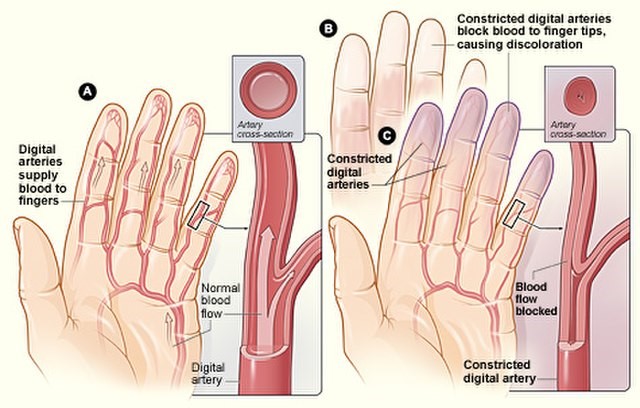
תופעת ריינו (לעיתים נקראת פשוט ריינו), היא מצב שבו כלי הדם הקטנים באצבעות הופכים לצרים (מתכווצים). זה קורה לרוב כאשר הם נמצאים בסביבה קרירה. כלי דם לקצוות אחרים כמו אצבעות הרגליים, האוזניים והאף עשויים גם הם להיות מושפעים. היא נקראת על שם ד"ר מוריס ריינו, האיש שתיאר אותה לראשונה בשנת 1862.
מאת ד"ר היילי וילאסי, FRCGP
שאלות נפוצות
Can Buerger's disease be prevented?
While the exact cause of Buerger's disease is not fully understood, it is strongly linked to smoking. The number of people developing Buerger's disease is decreasing as smoking rates decline, suggesting that avoiding tobacco use, including chewing tobacco and even secondhand smoke, may help prevent the condition from starting or progressing.
Is Buerger's disease contagious?
No, Buerger's disease is not contagious. It is an inflammatory condition primarily triggered by smoking, affecting the small and medium-sized blood vessels in the arms and legs.
Are there any alternative therapies that can help with Buerger's disease?
The article does not discuss alternative therapies. However, it does highlight some self-help measures that can be useful. These include avoiding cold temperatures, wearing well-fitting protective footwear, gentle exercise to improve circulation, and gentle massage and warmth to increase circulation. It is also advised to avoid sitting or standing in one position for long periods and to avoid tight-fitting or restrictive clothes.
If I stop smoking, will my Buerger's disease go away completely?
While there is no cure, stopping smoking is the most effective treatment. When you quit, Buerger's disease can become inactive. Studies show that a high percentage of people (94%) who quit smoking avoid amputation, suggesting that stopping smoking can halt the progression of the disease and significantly improve the outcome.
Why is nicotine replacement therapy not recommended for Buerger's disease?
The article states that any form of nicotine seems to make the condition worse. Therefore, nicotine replacement therapy, which still delivers nicotine, should not be used by individuals with Buerger's disease.
קריאה נוספת והפניות
- Thromboangiitis obliterans (Buerger Disease); DermNet NZ
- Ketha SS, Cooper LT; The role of autoimmunity in thromboangiitis obliterans (Buerger's disease). Ann N Y Acad Sci. 2013 May;1285:15-25. doi: 10.1111/nyas.12048. Epub 2013 Mar 19.
- Fazeli B, Rezaee SA; A review on thromboangiitis obliterans pathophysiology: thrombosis and angiitis, which is to blame? Vascular. 2011 May-Jun;19(3):141-53. doi: 10.1258/vasc.2010.ra0045.
- Rivera-Chavarria IJ, Brenes-Gutierrez JD; Thromboangiitis obliterans (Buerger's disease). Ann Med Surg (Lond). 2016 Mar 29;7:79-82. doi: 10.1016/j.amsu.2016.03.028. eCollection 2016 May.
אודות המחברצפה בפרופיל המלא
עודכן על ידי

Dr Laurence Knott
רופא כללי, מחבר רפואי
תואר ראשון (בהצטיינות) בביוכימיה, דוקטור לרפואה
ד"ר לורנס קנוט הוסמך בשנת 1973 ויש לו ניסיון נרחב כרופא כללי.
אודות המבקרצפה בפרופיל המלא

ד"ר אדריאן בונסול, MBBS
מחבר רפואי
תואר שני (כימיה), דוקטור לרפואה (בהצטיינות), דיפלומה ברפואת ילדים
מאז שנת 2000 אדריאן מועסק ברפואת ילדים דחופה וטיפול נמרץ בסידני, עם עניין מיוחד בטוקסיקולוגיה, טראומה והחייאה.
אנשי מקצוע רפואיים
Looking for more in-depth clinical detail? Our Professional Reference articles are written for doctors, nurses and other healthcare professionals. They include comprehensive clinical guidance, diagnostic information and UK/European evidence summaries. If you need the clinical version, you can read the Professional Reference article on this topic.
שתפו את מחשבותיכם או חוויותיכם עם אחרים ב קהילות המטופלים שלנו.
גישה פשוטה לטיפולים ושירותי בריאות אמינים באינטרנט.
Common conditions
Get help with common conditions through the NHS, without a GP appointment.





הירשמו לניוזלטר של פיישנט
המנה השבועית שלך של עצות בריאות ברורות ואמינות - נכתבה כדי לעזור לך להרגיש מעודכן, בטוח ובשליטה.
על ידי הרשמה אתה מקבל את שלנו מדיניות הפרטיות שלנו. באפשרותך לבטל את המנוי בכל עת. לעולם לא נמכור את הנתונים שלך.