ברכיים פונות פנימה
נבדק על ידי Dr Doug McKechnie, MRCGPעודכן לאחרונה על ידי ד"ר היילי וילאסי, FRCGP עודכן לאחרונה 15 Jun 2023
עומד בהנחיות העריכה של Patient
- הורדהורד
- שתף
- Language
- דיון
- גרסת שמע
- הוסף למקורות מועדפים בגוגל
ברכיים נוקשות מתארות זווית לא רגילה של הרגליים התחתונות. לרוב זהו מצב נורמלי בהתפתחות רגלי ילדים, אך לעיתים אצל ילדים או מבוגרים זה יכול לגרום לבעיות או להיות בעל סיבה בסיסית. רוב הילדים שיש להם ברכיים נוקשות מתגברים על המצב.
במבט חטוף
Knock knees is when your knees touch but your ankles are apart when standing.
It is a normal part of growth in children, usually from ages 2 to 8.
Most cases of knock knees correct themselves without treatment.
See a doctor if only one leg is affected, or if there is pain or difficulty walking.
You should also see a doctor if knock knees appear before age 2 or after age 8.
What are knock knees?
The medical term for knock knees is 'genu valgum' - genu meaning 'knee' in Latin, and valgum meaning 'bending outwards'. In knock knees, if the knees touch it is the lower leg which seems bent outwards. So if you have knock knees you are unable to stand with your knees AND your ankles together.
As children grow up, they tend to start off 'bow-legged'. This means if their feet are together, their knees are apart, leaving a diamond shape between the legs. This is normal in babies and toddlers until the age of about 2 years.
As the child's leg bones grow and develop, they then tend to take on a 'knock-kneed' shape. Now if their knees are together, their feet and ankles are apart. It tends to be most obvious around the age of 3 or 4 years, usually gradually improving to the correct position after that, as the child stands for longer periods of time. Knock knees are normal up to the age of 7 or 8 years, although the condition may last longer.
Valgus
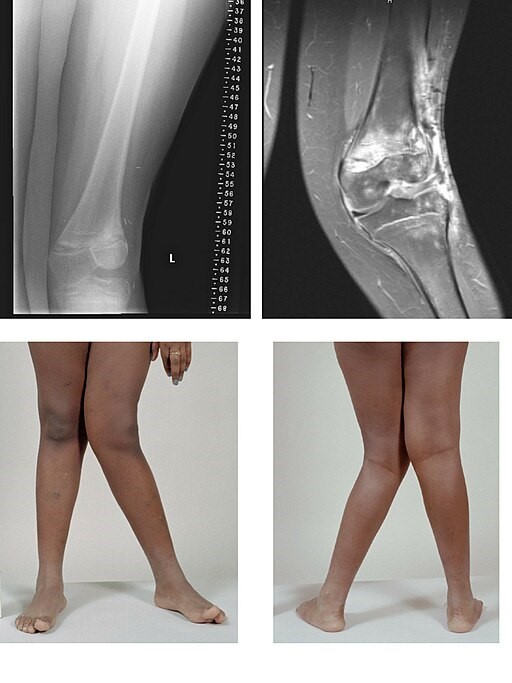
© BioMed Central, CC BY 2.0, via Wikimedia Commons
Do knock knees cause any problems?
Knock knees in children do not cause problems. If the condition is severe, or caused by an underlying problem, it may cause pain or difficulty walking.
Causes of knock knees
In most cases, knock knees are purely caused by the normal phase of growth and development. Occasionally - in either older children or adults - there can be an underlying problem causing the condition. For example:
Vitamin deficiency (particularly vitamin D deficiency causing rickets). Vitamin C and calcium deficiency can also affect the way bones grow.
Operations or injuries to the knee or legs.
Inherited (genetic) conditions which affect the way that the knees develop.
Do I need to see a doctor about knock knees?
You do not need to see a doctor if your child is at an age where having knock knees is normal (aged more than 2 years and less than 8 years) and if the deformity is not very severe. If your child lies on their back with their knees together, you can measure the distance between their ankles.
If it is less than 10 cm around age 4 years, this is likely to correct itself as they grow. If you take photos of your child every 3-6 months, standing with their knees together, you should see that the legs gradually become straighter from the age of 4 years or so.
See a doctor if:
Only one leg is affected.
Your child has knock knees before the age of 2 years or after the age of 8 years.
There is a larger gap between the ankles than that described above.
Your child has pain in the lower legs or knees.
Your child has problems walking or walks with a limp.
You develop knock knees as an adult.
How are knock knees diagnosed?
The diagnosis of knock knees can be made by just looking at a child. If it is particularly severe, or if it occurs outside the normal age range, then further tests may be needed. This might include קרני רנטגן או בדיקות דם.
The severity of the knock knees can be assessed by measuring the distance between the ankles when the child is standing with knees together. or by measuring other angles of the legs.
Treatment for knock knees
In most cases no treatment is needed. For children who develop knock knees as a normal part of their childhood growth, the condition corrects itself as they continue to grow. They do not need any special shoes or braces, and do not need to avoid any sporting activities. They do not need any physiotherapy or other special treatment.
If the condition is severe, or caused by an underlying problem, then treatment may be needed. This will then depend on the underlying condition, the severity of the deformity and the stage of growth that the child is in.
If the knock knees are caused by a metabolic problem, such as Vitamin D deficiency, the deformity may correct with vitamin replacement.
If the angle of bone growth is around 15-20 degrees in a child who is less than 10 years old, guided growth may be suitable to treat knock knees. Plates, or screws or staples may be implanted into the bone to aid correct growth.
Occasionally an operation to correct the deformity is needed. This is called an osteotomy and is usually followed by physiotherapy.
What is the outlook for children with knock knees?
Children who have knock knees as part of their normal growth pattern do very well without any medical assistance. Children who have an underlying condition can also do very well as long as their condition is recognised and treated. Complications only usually occur when an underlying condition is missed.
בחירות המטופלים עבור פיתוח

בריאות ילדים
דלקת מפרקים אידיופתית של גיל הילדות
Juvenile idiopathic arthritis is a condition in which persisting joint inflammation first occurs in children under the age of 16 years. Affected joints become painful and swollen, and can become damaged. Juvenile idiopathic arthritis cannot generally be cured but there are effective treatments. These help symptoms, prevent any long-standing joint problems, and can lead to remission.
מאת ד"ר דאג מקקנזי, MRCGP

בריאות ילדים
דיסלקציה
Dyslexia is common. It is usually first noticed during the first few years at school. There is no cure but early diagnosis and good help and support are essential and can be very effective.
מאת ד"ר קולין טיידי, MRCGP
שאלות נפוצות
At what age do knock knees typically develop in children?
Knock knees tend to become most noticeable around the age of 3 or 4 years. Before this, babies and toddlers up to about 2 years old are usually bow-legged.
Can adults develop knock knees?
While knock knees are commonly a normal part of childhood growth, adults can develop them due to underlying issues such as rheumatoid arthritis, osteoarthritis, obesity, or previous injuries or operations to the knee or legs. If an adult develops knock knees, it's recommended to see a doctor.
What is the typical progression of knock knees in children?
Children usually start bow-legged, then transition to knock-kneed, most visibly around ages 3-4. This typically improves naturally to a corrected position as they continue to grow and stand more, usually normalizing by age 7 or 8, though it can last longer.
Do knock knees always correct themselves without intervention?
In most cases, knock knees in children that are part of normal growth will correct themselves without any treatment. However, if they are severe, caused by an underlying problem, or occur outside the typical age range, treatment or medical assessment may be necessary.
Are specific exercises or physiotherapy needed for knock knees in children?
No, for children whose knock knees are part of their normal growth and development, special shoes, braces, physiotherapy, or other special treatments are generally not needed. They can also continue to participate in sporting activities without restriction.
קריאה נוספת והפניות
- Rerucha CM, Dickison C, Baird DC; Lower Extremity Abnormalities in Children. Am Fam Physician. 2017 Aug 15;96(4):226-233.
- Patel M, Nelson R; Genu Valgum.
- Soheilipour F, Pazouki A, Mazaherinezhad A, et al; The Prevalence of Genu Varum and Genu Valgum in Overweight and Obese Patients: Assessing the Relationship between Body Mass Index and Knee Angular Deformities. Acta Biomed. 2020 Oct 5;91(4):ahead of print. doi: 10.23750/abm.v91i4.9077.
אודות המחברצפה בפרופיל המלא

Dr Hayley Willacy, FRCGP
רופא כללי, מחבר רפואי
MBChB (1992), DRCOG, DFFP, MRCOG (Part 1) MRCGP (2007), DFSRH (2013), MSc - medical education (2020)
ד"ר היילי וילאסי הייתה רופאה כללית ב-NHS שעבדה בצפון מערב אנגליה, ופרשה מעבודתה הקלינית בשנת 2022 לאחר 30 שנות עבודה.
אודות המבקרצפה בפרופיל המלא

Dr Doug McKechnie, MRCGP
כותב רפואי
MA, MBBS, MSc, DRCOG, MRCP(UK), MRCGP(2021), FHEA
ד"ר דאג מקקני הוא רופא משפחה ב-NHS העובד בלונדון. הוא עובד במשרה מלאה קלינית ומשמש גם כסגן ראש המודול לפרקטיקה קלינית ומקצועית בבית הספר לרפואה של יוניברסיטי קולג' לונדון.
היסטוריית המאמר
המידע בעמוד זה נכתב ונבדק על ידי קלינאים מוסמכים.
המאמר זמין גם ב אנגלית, גרמנית, ספרדית, צרפתית, איטלקית, פורטוגזית, הינדי, עברית, ערבית, and שוודית.
הסקירה הבאה מתוכננת ל: 12 במאי 2028
15 Jun 2023 | הגרסה האחרונה

שאלו, שתפו, התחברו.
עיין בדיונים, שאל שאלות ושתף חוויות במאות נושאים בריאותיים.

מרגיש לא טוב?
הערך את הסימפטומים שלך באינטרנט בחינם
הירשמו לניוזלטר של פיישנט
המנה השבועית שלך של עצות בריאות ברורות ואמינות - נכתבה כדי לעזור לך להרגיש מעודכן, בטוח ובשליטה.
על ידי הרשמה אתה מקבל את שלנו מדיניות הפרטיות שלנו. באפשרותך לבטל את המנוי בכל עת. לעולם לא נמכור את הנתונים שלך.
עוד בבריאות ילדים
- השמנת יתר בילדות
- עצירות אצל ילדים
- דושן ניוון שרירים
- האכלה של תינוקות פגים
- חום אצל ילדים
- מחלת הירשפרונג
- כאב בטן בצד שמאל אצל ילדים
- זיהום מנינגוקוקלי
- חיסון מנינגוקוקלי לדלקת קרום המוח
- בחילות והקאות
- נמק מעי נמקי
- נורובירוס
- חיסון פנאומוקוקלי
- כאב בטן חוזר אצל ילדים
- כאב ברביע הימני התחתון אצל ילדים
- רוזולה
- חסימת דרכי דמעות בתינוקות
- תולעי חוט
- טיפול בבעיות בריאות של יילודים
- תסמונת טרנר