קרע על שם מאלורי-וייס
נבדק על ידי ד"ר היילי וילאסי, FRCGP עודכן לאחרונה על ידי Dr Philippa Vincent, MRCGPעודכן לאחרונה 23 מרץ 2023
עומד בהנחיות העריכה של Patient
- הורדהורד
- שתף
- Language
- דיון
- גרסת שמע
- הוסף למקורות מועדפים בגוגל
בסדרה זו:הקאת דם
תסמונת מאלורי-וייס (המכונה גם קרע מאלורי-וייס) היא השם שניתן לדימום ותסמינים אחרים הנגרמים על ידי קרע ברירית החלק העליון של מערכת העיכול. בדרך כלל מאבחנים זאת באמצעות בדיקה הנקראת גסטרוסקופיה (אנדוסקופיה). זה כולל החדרת צינור דרך הוושט אל הקיבה. במקרים רבים, הדימום נפסק עד שמבוצעת הגסטרוסקופיה ואין צורך בטיפול ספציפי. הקרע בדרך כלל מחלים מעצמו לאחר מספר ימים.
במבט חטוף
Mallory-Weiss syndrome is bleeding from a tear in the lining of the upper part of the gut.
It is often caused by a sudden rise in pressure in the stomach, such as from vomiting.
Symptoms include vomiting bright red blood, dark stools, and tummy pain.
A gastroscopy is used to diagnose Mallory-Weiss syndrome and treat any bleeding.
The outlook is usually very good, with bleeding often stopping by itself.
Medical attention should be sought quickly if you have symptoms like vomiting blood.
מהו תסמונת מאלורי-וייס?
Upper gut
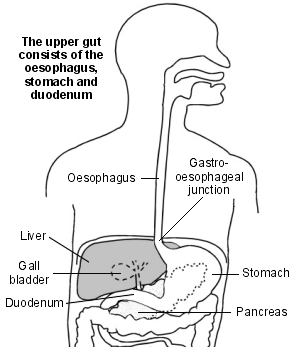
Mallory-Weiss syndrome (also called Mallory-Weiss tear) is the name given to bleeding and other symptoms caused by a tear in the lining of the upper part of the gut (gastrointestinal tract). The upper gut consists of the gullet (oesophagus), stomach and duodenum.
The tear usually occurs at one of two particular places in the upper gut:
The gastro-oesophageal junction - the part of the upper gut where the gullet joins the stomach; או
Within the lining of the upper part of the stomach.
Mallory-Weiss syndrome was first described in 1929 by two doctors called Mallory and Weiss. They had noticed it in people retching and being sick (vomiting) after bingeing on alcohol.
What causes Mallory-Weiss syndrome?
The tear in the lining of the gut that occurs in Mallory-Weiss syndrome can be caused by anything that leads to a sudden rise in pressure in the stomach or the lower part of the gullet (oesophagus). Repeated vomiting and retching after binge drinking, because of severe morning sickness during pregnancy, or because of bulimia nervosa (episodes of binge eating followed by self-induced vomiting) are among the most common causes of Mallory-Weiss syndrome.
Any condition that causes vomiting or coughing, however, can cause this tear to happen. Less commonly it happens because of violent coughing, hiccupping, excessive straining or heavy lifting. Sometimes an obvious cause for the tear cannot be found.
Who does Mallory-Weiss syndrome affect?
The problem tends to affect people aged in their 30s to 50s, although it can occur at any age. It is more common in men than in women and is also more common in people with a hiatus hernia. (A hiatus hernia occurs when part of the stomach pushes up into the lower chest through a weakness in the diaphragm - the large flat muscle that lies between the lungs and the tummy area. See the separate leaflet called Hiatus Hernia for more details.) It is also more common in patients who drink alcohol above recommended limits.
What are the symptoms of Mallory-Weiss syndrome?
Most people with Mallory-Weiss syndrome will bring up (vomit) an amount of bright red blood. This will often happen after a bout of normal retching or vomiting. The amount of bleeding (and so blood vomited as a result) varies from person to person. Most people have just a small amount of bleeding but sometimes there can be a lot of blood lost.
Other symptoms can be:
Dark black or tarry-coloured foul-smelling stools (faeces) - this is known as melaena and is caused by blood from the upper part of the gastrointestinal tract changing as it moves through the lower part.
Severe pain in the upper part of the tummy (abdomen).
Dizziness and light-headedness due to the blood loss.
התעלפות.
הערה: there are many other conditions that can lead to vomiting blood. For example, a כיב קיבה, stomach inflammation (gastritis) or inflammation of the gullet (oesophagus). See the separate leaflet called Vomiting Blood (Haematemesis) for more details. About 5% of cases of bleeding from the upper part of the gut are caused by a Mallory-Weiss tear. Medical attention should be sought quickly with the above symptoms.
How is Mallory-Weiss syndrome diagnosed?
Mallory-Weiss syndrome is usually diagnosed by having a gastroscopy (sometimes known as an endoscopy or an OGD - oesophago-gastro-duodenoscopy).
A gastroscopy is a test where a clinician looks into the upper part of the gut using an endoscope. . An endoscope is a thin, flexible telescope which is about as thick as a little finger.
The endoscope is passed through the mouth, into the gullet (oesophagus) and down towards the stomach and duodenum. The tip of the endoscope contains a light and a tiny video camera so the operator can see inside the gut. The endoscope also has a side channel down which various instruments can pass in order to be used by the operator.
For further details see the separate leaflet called Gastroscopy (Endoscopy).
A gastroscopy allows the operator to see if a Mallory-Weiss tear is present in the gut lining, as well as its location. They will also be able to see if the tear is still bleeding.
Endoscopic image of Mallory-Weiss tear
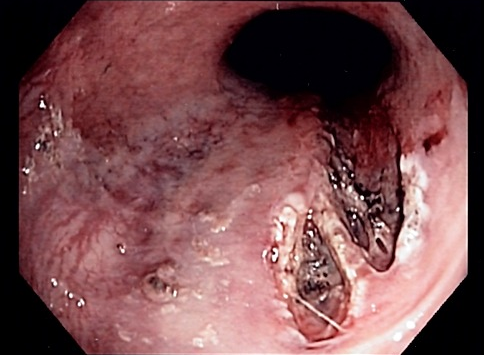
© Samir,CC BY-SA 3.0, via Wikimedia Commons
What is the treatment for Mallory-Weiss syndrome?
The first thing that doctors and nurses will do if they suspect Mallory-Weiss syndrome is to make sure that the person's condition is stable. If a lot of blood has been lost, fluids may be given into the veins (intravenously). Sometimes a transfusion of blood may be given. Blood pressure and pulse rate will be closely watched so that the medical staff can check the response to any treatment.
Blood tests will usually be carried out - for example, to check for אנמיה (to see how much blood has been lost because of the bleeding) and to check that the blood is clotting normally. Medication may be given to help with symptoms of feeling sick (nausea) or being sick (vomiting).
If people do not show any signs of ongoing bleeding and their condition is stable, they may not be admitted to hospital but may be followed up as an outpatient.
Management will depend on whether the Mallory-Weiss tear is still bleeding when the gastroscopy is carried out. In many cases the bleeding has stopped by the time gastroscopy takes place.
If the Mallory-Weiss tear is still bleeding
If the tear is still bleeding, treatment to stop the bleeding is usually given during the gastroscopy. A number of different treatments are available including:
The tear can be repaired, or closed, using special metal clips passed via the side channel . This is known as haemoclipping.
A band can be used to tie off a bleeding blood vessel. This is known as band ligation.
A heater probe may be passed down the side channel of the endoscope to apply a heat source to the bleeding blood vessels, to stop the bleeding.
Adrenaline (epinephrine) may be injected around the bleeding point. This medication causes closure (constriction) of the bleeding blood vessels thus stopping the bleeding
A combination of these treatments may be used
Very rarely, the above treatments do not stop the bleeding. In this case a procedure known as angiography with embolisation may be used. A special dye is injected into the bloodstream and X-rays are taken which show up the blood vessels (called angiography). In this way, doctors can see where the bleeding is coming from. A substance is then injected directly into the bleeding blood vessel either to stop the bleeding or to block it off (this is called embolisation).
Rarely, surgery is needed to treat Mallory-Weiss syndrome by sewing up the tear if other treatments have failed to stop the bleeding
If the Mallory-Weiss tear has stopped bleeding
If the tear is found to have stopped bleeding by the time gastroscopy takes place then no specific treatment may be needed. The tear should heal by itself. The person may be observed in hospital for a period of time so that they can be monitored closely to ensure that bleeding doesn't return (recur). Medication to suppress stomach acid may be given to help the tear heal.
What is the outlook for Mallory-Weiss syndrome?
The outlook (prognosis) is generally very good. In most people, the bleeding stops by itself and no specific treatment is needed. Mallory-Weiss tears usually heal quickly (within a few days).
Can Mallory-Weiss syndrome return?
It is not common for Mallory-Weiss syndrome to return (recur). However, if someone has had Mallory-Weiss syndrome in the past, there is the possibility of the condition recurring It is more likely to occur again if the bleeding was extremely heavy the first time.
בחירות המטופלים עבור מצבים עיכוליים אחרים

בריאות מערכת העיכול
דלקת לבלב חריפה
דלקת לבלב חריפה היא דלקת של הלבלב שמתפתחת במהירות. התסמין העיקרי הוא כאב בטן. בדרך כלל היא חולפת תוך כמה ימים, אך לפעמים היא הופכת לחמורה ורצינית מאוד. הגורמים השכיחים ביותר לדלקת לבלב חריפה הם אבני מרה ושתיית אלכוהול מעל המגבלות המומלצות.
מאת ד"ר פיליפה וינסנט, MRCGP

בריאות מערכת העיכול
דלקת לבלב כרונית
דלקת לבלב כרונית יכולה לגרום לכאבי בטן, עיכול לקוי, סוכרת וסיבוכים נוספים. אלכוהול הוא הגורם הנפוץ. הטיפול כולל משככי כאבים, תרופות אחרות, והכי חשוב, הפסקת שתיית אלכוהול לצמיתות. לעיתים נדרשת ניתוח.
מאת ד"ר דאג מקקנזי, MRCGP
שאלות נפוצות
Can vomiting cause a tear in my gullet or stomach lining?
Yes, anything that causes a sudden rise in pressure in the stomach or lower gullet can lead to a tear. Repeated vomiting or retching are common causes. This can occur due to various reasons, such as severe morning sickness during pregnancy, bulimia nervosa, or even violent coughing, hiccupping, or excessive straining.
How quickly do Mallory-Weiss tears typically heal?
Mallory-Weiss tears usually heal quickly, often within just a few days. If the bleeding has stopped by the time a gastroscopy is performed, no specific treatment might be needed, and the tear should heal on its own.
What kind of symptoms indicate I should seek urgent medical attention for potential Mallory-Weiss syndrome?
You should seek quick medical attention if you experience vomiting bright red blood, particularly after retching. Other concerning symptoms include dark, black, or tarry stools (melaena), severe upper abdominal pain, dizziness, light-headedness, or fainting.
What is angiography with embolisation, and when is it used for Mallory-Weiss syndrome?
Angiography with embolisation is a procedure used in very rare cases when other treatments have failed to stop the bleeding from a Mallory-Weiss tear. During this procedure, a special dye is injected into your bloodstream, and X-rays are taken to pinpoint where the bleeding is coming from. Then, a substance is injected directly into the bleeding blood vessel to stop or block it off.
Are there any medications that can help a Mallory-Weiss tear heal?
If a Mallory-Weiss tear has stopped bleeding on its own, doctors may prescribe medication to suppress stomach acid. This can help the tear to heal more effectively.
קריאה נוספת והפניות
- Holster IL, Kuipers EJ; ניהול דימום חריף לא-דליתי במערכת העיכול העליונה: מדיניות נוכחית ופרספקטיבות עתידיות. World J Gastroenterol. 2012 מרץ 21;18(11):1202-7.
- Wilkins T, Khan N, Nabh A, et al; Diagnosis and management of upper gastrointestinal bleeding. Am Fam Physician. 2012 Mar 1;85(5):469-76.
- דימום חריף במערכת העיכול העליונה אצל בני 16 ומעלה: ניהול; הנחיות קליניות של NICE (אוגוסט 2016)
- Rawla P, Devasahayam J; תסמונת מלורי וייס. סובה הבריאות, מרטינסוויל, וירג'יניה, אוניברסיטת דרום דקוטה, 2022.
- National Clinical Guideline Centre (UK) - Acute Upper Gastrointestinal Bleeding: Management; London: Royal College of Physicians (UK), 2012
אודות המחברצפה בפרופיל המלא

ד"ר מישל רייט, MRCGP
רופא כללי, מחבר רפואי
MB, ChB, MRCGP, DCH, DRCOG
ד"ר מישל רייט קיבלה את הכשרתה בשנת 1997 בבריטניה ועבדה כרופאה כללית בלונדון לפני שעברה לשווייץ. היא כותבת עבור EMIS מאז 2007.
אודות המבקרצפה בפרופיל המלא

Dr Hayley Willacy, FRCGP
רופא כללי, מחבר רפואי
MBChB (1992), DRCOG, DFFP, MRCOG (Part 1) MRCGP (2007), DFSRH (2013), MSc - medical education (2020)
ד"ר היילי וילאסי הייתה רופאה כללית ב-NHS שעבדה בצפון מערב אנגליה, ופרשה מעבודתה הקלינית בשנת 2022 לאחר 30 שנות עבודה.
היסטוריית המאמר
המידע בעמוד זה נכתב ונבדק על ידי קלינאים מוסמכים.
המאמר זמין גם ב אנגלית, גרמנית, ספרדית, צרפתית, איטלקית, פורטוגזית, הינדי, עברית, ערבית, and שוודית.
הסקירה הבאה מתוכננת ל: 21 מרץ 2028
23 מרץ 2023 | הגרסה האחרונה
15 Dec 2011 | פורסם במקור
נכתב על ידי:
ד"ר מישל רייט, MRCGP

שאלו, שתפו, התחברו.
עיין בדיונים, שאל שאלות ושתף חוויות במאות נושאים בריאותיים.

מרגיש לא טוב?
הערך את הסימפטומים שלך באינטרנט בחינם
הירשמו לניוזלטר של פיישנט
המנה השבועית שלך של עצות בריאות ברורות ואמינות - נכתבה כדי לעזור לך להרגיש מעודכן, בטוח ובשליטה.
על ידי הרשמה אתה מקבל את שלנו מדיניות הפרטיות שלנו. באפשרותך לבטל את המנוי בכל עת. לעולם לא נמכור את הנתונים שלך.
עוד בבריאות מערכת העיכול
- כאב בטן
- ריפלוקס חומצי ואזופגיטיס
- דלקת לבלב חריפה
- נוגדי חומצה
- סרטן המעי
- בדיקת סרטן המעי הגס
- דלקת כיס המרה
- עצירות אצל ילדים
- מחלת קרוהן
- תסמונת הקאות מחזורית
- דיספפסיה תפקודית
- אבני מרה
- גסטרופרזיס
- ג'יארדיה
- תחת מגרד
- ביופסיית כבד
- כולנגיטיס סקלרוזינג ראשוני
- כאב ברביע הימני התחתון אצל ילדים
- כאב ברביע הימני התחתון בהריון
- שלשול של מטיילים