פרסביופיה
Age-related long sight
נבדק על ידי Dr Philippa Vincent, MRCGPעודכן לאחרונה על ידי Dr Colin Tidy, MRCGPעודכן לאחרונה 15 ינואר 2024
עומד בהנחיות העריכה של Patient
- הורדהורד
- שתף
- Language
- דיון
- Ask Patient
- גרסת שמע
- הוסף למקורות מועדפים בגוגל
בסדרה זו:רוחק ראייה
רוחק ראייה הקשור לגיל (פרסביופיה) הוא חלק נורמלי מההזדקנות ואינו מחלה. ככל שמתבגרים, קשה יותר לראות (להתמקד) בעצמים קרובים. ניתן לתקן את הבעיה על ידי הרכבת משקפי קריאה או עדשות מגע. פרסביופיה היא סוג של בעיית ראייה הנקראת שגיאת שבירה.
במבט חטוף
Presbyopia is a type of long-sightedness that happens as you get older.
It is caused by the lens in your eye becoming stiffer and less elastic.
Symptoms often include difficulty reading small print and eye strain, especially in dim light.
Presbyopia usually becomes noticeable around age 40 and most people need reading glasses by 45.
It can be treated with glasses, contact lenses, or surgery.
If you notice any changes in your vision, you should have your eyes checked.
What is presbyopia?
Presbyopia is a long-sight (hypermetropia) eye condition, caused by age.
As part of the ageing process the lens becomes more stiff and less elastic. This makes it more difficult for the lens to change shape - the ciliary muscles have to work harder to make it do so.
Eventually they are unable to do this at all and the lens cannot be thickened. With the lens in its normal resting position you are still able to focus on objects in the distance. However, because the lens cannot thicken, it cannot manage the extra degree of focus (accommodation) which is needed for near objects.
In order to see close-up objects, our eyes have to accommodate. This means that the lens has to change its thickness. Its thickness is adjusted by the ciliary muscles that attach to the suspensory ligaments at either end.
As these muscles tighten, the ligaments lengthen and the lens becomes more thickened and curved. Light rays entering your eye from close objects are brought into sharp focus on the retina.
At what age does presbyopia start?
Presbyopia is a normal part of the ageing process and usually becomes noticeable at around age 40.
By the age of 45 years, most people will need reading glasses. If you already wear glasses or contact lenses, your prescription may alter as a result of age-related long sight.
Types of presbyopia
There are five types of presbyopia:
Incipient presbyopia. This is the very earliest stage, when it may be a bit more difficult to read small print.
Functional presbyopia. This occurs when you begin to notice more problems with near sight.
Absolute presbyopia. If you have this type, your eyes cannot focus on near objects at all (farsightedness).
Premature presbyopia. This term is used when presbyopia occurs before the age of 40 years.
Nocturnal presbyopia. When this occurs, focusing on near objects is particularly difficult in low light conditions.
Presbyopia symptoms
Presbyopia symptoms may start with difficulties with prolonged close-up work, with tiring (eye strain) of the eyes. This may be worse in dim light.
People with presbyopia may also notice:
Difficulty in adjusting vision if you look quickly from a near object to a faraway one.
Blurred vision when looking at objects close up such as reading material.
כאבי ראש.
Eye strain when focusing on close work.
What causes presbyopia?
Presbyopia is a refractive error (see below) caused by normal ageing.
People who have a job that requires a lot of close-up work and people who live and work in a hot climate with lots of ultraviolet sunlight exposure are also at higher risk of premature age-related long sight.
מהו ליקוי תשבורת?
To understand what causes presbyopia, we need to understand what a refractive error is. . Refractive errors are an eyesight problem and a common reason for reduced level of eyesight (visual acuity).
חתך רוחב של העין
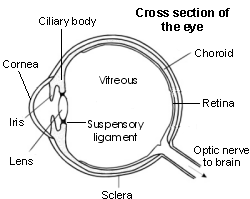
שבירת אור מתייחסת לכיפוף האור, במקרה זה על ידי העין, כדי למקד אותו. ליקוי תשבורת פירושו שהעין אינה מסוגלת למקד את האור כראוי על הרשתית. הדבר מתרחש בדרך כלל עקב חריגות בצורת גלגל העין, או משום שהגיל השפיע על תפקודם של חלקי העין האחראים למיקוד.
ישנם ארבעה סוגים של שגיאות תשבורת:
Age-related long sight (presbyopia).
אסטיגמציה (ליקוי תשבורת הנגרם עקב קרנית בעלת עקמומיות לא אחידה).
כדי להבין באופן מלא את שגיאות השבירה, מועיל לדעת כיצד אנו רואים.
When we look at an object, light rays from the object pass through the eye to reach the retina. This causes nerve messages to be sent from the cells of the retina down the optic nerve to the vision centres in the brain. The brain processes the information it receives, so that in turn, we can see.
מיקוד העין
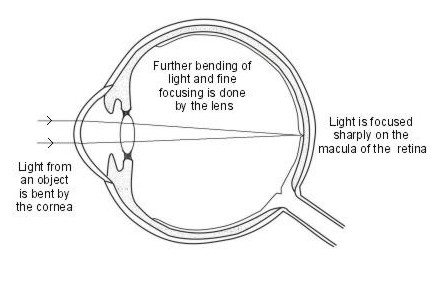
Light rays come off an object in all directions, as they result from the light around us from sun, moon and artificial light bouncing back off the object. The part of this bounced light that come into the eye from an object needs to be focused on a small area of the retina. If this doesn't happen, what we look at will be blurred.
The cornea and lens have the job of focusing light. The cornea does most of the work, as it (refracts) the light rays which then go through the lens, which finely adjusts the focusing. The lens does this by changing its thickness. This is called accommodation. The lens is elastic and can become flatter or more rounded. The more rounded (convex) the lens, the more the light rays can be bent inwards.
The shape of the lens is varied by the small muscles in the ciliary body. Tiny string-like structures called the suspensory ligaments are attached at one end to the lens and at the other to the ciliary body. This is a bit like a trampoline with the central bouncy bit being the lens, the suspensory ligaments being the springs and the ciliary muscles being the rim around the edge.
כאשר השרירים הריסניים בגוף הריסני מתכווצים, הרצועות התומכות מתרפות, מה שגורם לעדשה להתעבות. זה קורה עבור עצמים קרובים. לצפייה בעצמים רחוקים, השריר הריסני נרפה, מה שגורם לרצועות התומכות להתהדק, והעדשה נעשית דקה יותר.
נדרש כיפוף (שבירה) רב יותר של קרני האור כדי להתמקד באובייקטים קרובים, כמו בעת קריאה. נדרש כיפוף פחות של האור כדי להתמקד באובייקטים רחוקים.
Presbyopia treatment
משקפיים
Presbyopia can be corrected by wearing reading glasses; often the lenses are similar to bifocal lenses. If you already have glasses, bifocal or varifocal lenses may be prescribed to treat your age-related long sight. With these lenses, different parts of the lens have different prescriptions.
Bifocal ('bi' means two) lenses have a lens at the bottom for long sight (to allow close-up vision) and the rest of the lens above (allowing distant vision). Multifocal lenses have at least three focus 'zones' - for distant, middle and near vision, with gradual changes between them. Middle vision is best imagined as that needed for computer screen work.
עדשות מגע
For people who already have contact lenses, reading glasses may be prescribed in addition to these to treat פרסביופיה.
Other options include bifocal or multifocal contact lenses, or wearing a different contact lens in each eye - one to allow near vision, the other for distance vision (monovision contact lenses).
The disadvantage of correcting one eye (effectively to make it slightly short-sighted) is some loss of distance vision in that eye - but the other eye retains good distance vision. Usually the two eyes adapt to the differences between them, so that the patient can see near and far equally well.
Distance vision can be slightly compromised - and some patients notice 'ghosting' (faint double vision) on distant objects which does not always resolve with time.
ניתוח
Various surgical options are now offered to correct presbyopia. Some of these work on the principle of correcting one eye for near vision, whilst correcting the other eye to give good distant vision:
שתל קרנית Kamra®
The Kamra® corneal inlay was approved by the US FDA in 2015. The inlay is designed to eliminate the need for reading glasses among people between the ages of 45 and 60 years who have good distance vision without glasses but have problems seeing up close due to age-related long sight.
The inlay is a small, thin opaque device with a tiny opening in the centre. It is surgically implanted in the central cornea, directly in front of the pupil of the eye. The central opening in the inlay creates a 'pinhole camera' effect. This effect, also seen if you look through a pinhole in a piece of paper, sharpens near vision while maintaining clear distance vision.
The inlay typically is implanted in the non-dominant eye. This allows both eyes to be used for distance vision, while the inlay sharpens near vision in the non-dominant eye.
ניתוח עיניים בלייזר
Monovision LASIK® (Laser-כsisted כn situ שeratomileusis) and PRK® (Photo-Refractive שeratectomy) can be used to remove corneal tissue and reshape the cornea to reduce the need for reading glasses. In monovision laser surgery for presbyopia, this is done for one eye only.
The surgeon fully corrects the distance vision of one eye (usually the dominant eye), and intentionally makes the non-dominant eye mildly short-sighted.
The newly short-sighted eye sees near objects clearly without glasses, although its distant vision may be less good. So, after monovision laser surgery, the dominant eye takes the lead to provide clear distance vision and the non-dominant eye is responsible for sharpening near vision.
See the leaflet on ניתוח לייזר בעיניים for further information.
קרטופלסטיקה מוליכה למונוביז'ן (CK)
CK uses low-level, radiofrequency energy to shrink fibres in the edge of the cornea to increase the curve and therefore increase its focusing power. Like monovision laser eye surgery, one eye is corrected for close vision and the other left for distance vision.
Monovision of any kind involves some compromise and not everyone adapts well to it. It's a good idea to try monovision with contact lenses before committing to a permanent surgical procedure, in case you don't adapt to it.
החלפת עדשה שבירה (RLE)
RLE is the removal and replacement of the eye's natural lens with an artificial lens to improve vision. The procedure is very similar to cataract surgery. The artificial lens is usually a multifocal lens, but various types are available.
RLE can reduce the need for reading glasses while providing clear distance vision without glasses. It is particularly helpful for patients with age-related long sight who are developing קטרקט.
Several other surgical procedures to correct presbyopia are either available or in development, depending on which country you live in. In the UK, these procedures are not routinely done in the NHS.
It is important that you know your facts, including what the procedure involves, the failure rate, side-effects, the risk of complications, ו level of aftercare provided.
You should be given the opportunity to discuss these facts in advance with the surgeon who will be carrying out the procedure.
How often should you have an eye test?
שירות הבריאות הלאומי ממליץ שרוב האנשים יבצעו בדיקת ראייה כל שנתיים. ילדים יקבלו בדיקות עיניים באופן שגרתי בשלבים שונים מגיל לידה ועד גיל בית ספר.
People at high risk of sight problems need more frequent eyesight checks.
This includes people with:
היסטוריה משפחתית של מצבים אלה.
אנשים מעל גיל 70 וילדים המרכיבים משקפיים עשויים להזדקק לבדיקות עיניים תכופות יותר.
You should get your eyes checked if you notice any changes in your vision.
ד"ר מרי לות' היא מחברת או המחברת המקורית של עלון זה.
בחירות המטופלים עבור מצבי עיניים
בריאות העין
אמבליופיה (עין עצלה)
אמבליופיה (לעיתים קרובות נקראת עין עצלה) פירושה שהראייה בעין אחת אינה מתפתחת במלואה במהלך הילדות המוקדמת. אמבליופיה היא בדרך כלל בעיה שניתן לתקן אם מטפלים בה מוקדם. טיפול מאוחר יכול לגרום לכך שהבעיה בראייה תישאר קבועה. פזילה (סטרביסמוס) היא אחת הסיבות הנפוצות ביותר לאמבליופיה. טיפול באמבליופיה כולל לגרום לעין העצלה לעבוד קשה יותר כדי לראות. זה נעשה בדרך כלל על ידי חסימת הראייה בעין הטובה עם רטייה או על ידי טשטוש הראייה בעין הטובה באמצעות טיפות עיניים אטרופין.
מאת ד"ר פיליפה וינסנט, MRCGP

בריאות העין
עכירויות בעין, הבזקי אור והילות
Eye floaters and flashes are common and are usually nothing to worry about. They usually occur because of normal changes that happen in the jelly-like substance inside the eye (vitreous humour) as you age. Haloes are bright circles around a source of light. They are also referred to as glare. They are a common symptom, particularly in older people. They can sometimes be a sign of underlying eye conditions such as glaucoma.
מאת ד"ר פיליפה וינסנט, MRCGP
שאלות נפוצות
What is the difference between presbyopia and other types of long sight?
Presbyopia is specifically age-related long sight, caused by the natural stiffening and loss of elasticity of the eye's lens over time. Other types of long sight (hypermetropia) are refractive errors where the eye cannot focus light correctly, often due to abnormalities in the shape of the eyeball, but are not necessarily tied to the ageing process of the lens itself.
Are bifocal contact lenses available for presbyopia?
Yes, bifocal or multifocal contact lenses are an option for treating presbyopia. Another approach is to use 'monovision' contact lenses, where a different prescription is used in each eye – one for near vision and the other for distance vision.
What does 'monovision' mean in the context of presbyopia treatment?
Monovision is a treatment approach that corrects one eye for near vision and the other eye for distance vision. This can be achieved with contact lenses or surgical procedures like LASIK, PRK, or conductive keratoplasty. The aim is for the brain to adapt and use the appropriate eye for the task, allowing for both near and distant vision without glasses.
What is the purpose of a Kamra corneal inlay?
The Kamra corneal inlay is a small, thin device with a central opening that is surgically implanted into one eye. It creates a 'pinhole camera' effect, which sharpens near vision while maintaining clear distance vision. It is typically implanted in the non-dominant eye for individuals between 45 and 60 who have good distance vision but struggle with close-up tasks due to presbyopia.
When should someone consider refractive lens exchange (RLE)?
Refractive lens exchange (RLE) involves replacing the eye's natural lens with an artificial multifocal lens. This procedure is similar to cataract surgery and can reduce the need for reading glasses while providing clear distance vision. It is particularly helpful for patients who have age-related long sight and are also beginning to develop cataracts.
קריאה נוספת והפניות
- תיקון לייזר של שגיאת תשבורת לאחר ניתוח עיניים לא תשבורתי; הנחיות NICE להליכים התערבותיים, מרץ 2011
- Corneal inlay implantation for correction of Presbyopia; NICE Interventional Procedure Guidance, April 2013
- Torricelli AA, Junior JB, Santhiago MR, et al; ניהול כירורגי של פרסביופיה. קלין אופתלמול. 2012;6:1459-66. doi: 10.2147/OPTH.S35533. פורסם באינטרנט 6 בספטמבר 2012.
- סטנדרטים מקצועיים לניתוחי תשבורת; הקולג' המלכותי לרפואת עיניים (דצמבר 2021)
- Katz JA, Karpecki PM, Dorca A, et al; פרסביופיה - סקירה של אפשרויות טיפול נוכחיות וטיפולים מתפתחים. קלין אופתלמול. 24 במאי 2021;15:2167-2178. doi: 10.2147/OPTH.S259011. אוסף אלקטרוני 2021.
- Wolffsohn JS, Davies LN, Sheppard AL; New insights in presbyopia: impact of correction strategies. BMJ Open Ophthalmol. 2023 Jan;8(1):e001122. doi: 10.1136/bmjophth-2022-001122.
אודות המחברצפה בפרופיל המלא
עודכן על ידי

Dr Colin Tidy, MRCGP
רופא כללי, מחבר רפואי
MBBS, MRCGP, MRCP (Paediatrics), DCH
ד"ר קולין טיידי הוא רופא ב-NHS, הממוקם באוקספורדשייר.
אודות המבקרצפה בפרופיל המלא

Dr Philippa Vincent, MRCGP
רופא כללי, מחבר רפואי
MB BS, Bsc, MRCGP (2000), DCH, DFSRH, DRCOG
ד"ר Philippa וינסנט הוא רופא משפחה ב-NHS העובד בצפון לונדון.
שתפו את מחשבותיכם או חוויותיכם עם אחרים ב קהילות המטופלים שלנו.
גישה פשוטה לטיפולים ושירותי בריאות אמינים באינטרנט.
Common conditions
Get help with common conditions through the NHS, without a GP appointment.





הירשמו לניוזלטר של פיישנט
המנה השבועית שלך של עצות בריאות ברורות ואמינות - נכתבה כדי לעזור לך להרגיש מעודכן, בטוח ובשליטה.
על ידי הרשמה אתה מקבל את שלנו מדיניות הפרטיות שלנו. באפשרותך לבטל את המנוי בכל עת. לעולם לא נמכור את הנתונים שלך.