מחלת וילסון
נבדק על ידי Dr Doug McKechnie, MRCGPעודכן לאחרונה על ידי Dr Philippa Vincent, MRCGPעודכן לאחרונה 20 ינואר 2025
עומד בהנחיות העריכה של Patient
- הורדהורד
- שתף
- Language
- דיון
- גרסת שמע
- הוסף למקורות מועדפים בגוגל
מחלת וילסון היא הפרעה גנטית שבה נחושת מצטברת בגוף, בעיקר בכבד ובמוח. ללא טיפול, הצטברות הנחושת יכולה לגרום לתסמינים חמורים. הטיפול כולל תרופות להסרת עודפי הנחושת ו/או למניעת הצטברות נוספת של נחושת.
במבט חטוף
Wilson's disease is a rare inherited condition where too much copper builds up in the body.
זה נגרם על ידי גן פגום שמונע מהגוף להיפטר מעודפי נחושת.
נחושת מצטברת בעיקר בכבד, במוח ובשכבה הקדמית של העין.
תסמינים מופיעים בדרך כלל בין הגילאים 6 ל-20, ומשפיעים על הכבד והמוח.
Diagnosis involves blood and urine tests, eye examination, or a liver biopsy.
הטיפול כולל תרופות להסרת נחושת או לחסימת ספיגתה, והוא לכל החיים.
מחלת וילסון ללא טיפול עלולה להיות קטלנית, בדרך כלל לפני גיל 40.
What is Wilson's disease?
Wilson's disease is a condition where too much copper builds up in the body. It is a rare inherited disorder that affects about 1 in 30,000 people. It is named after Dr Samuel Wilson who first described the disorder in 1912.
People who inherit the genetic fault in Wilson's disease are not able to get rid of copper from their body. Copper is a trace metal which is in many foods. Tiny amounts of copper are needed to remain healthy. Normally, the body gets rid of any excess copper. People with Wilson's disease cannot get rid of this excess copper and so it builds up in the body, mainly in the liver, the brain, the layer at the front of the eye (called the cornea) and the kidneys.
Too much copper in the liver cells (the hepatocytes) is harmful and leads to liver damage. Damage to brain tissue mainly occurs in an area called the lenticular nucleus. Hence, Wilson's disease is sometimes also called hepatolenticular degeneration.
What causes Wilson's disease?
In Wilson's disease, a particular gene on chromosome 13 does not work. The gene is called ATP7B. This gene normally controls the way the liver cells get rid of excess copper. Normally, the liver cells pass out excess copper into the bile. If this process does not work then the copper builds up in liver cells. When the copper storage capacity of the liver cells is exhausted, the copper spills into the bloodstream and deposits copper in other parts of the body, mainly the brain.
How is Wilson's disease inherited?
Wilson's disease is an autosomal recessive disorder. This means that, in order to develop Wilson's disease, two abnormal ATP7B genes must be inherited - one from each parent.
Wilson's inheritance
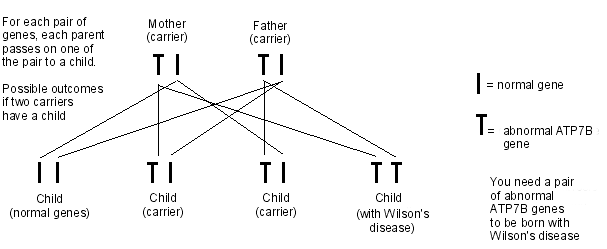
People who inherit only one copy of the abnormal gene are called carriers. Carriers do not have the disorder, as they have one normal gene which is enough to control the function of copper in the body. However, carriers can pass the abnormal gene on to their children.
How common is Wilson's disease?
About 1 in 100 people are carriers of the ATP7B gene. When two people who carry the abnormal gene have a child, there is a:
1 in 4 chance that the child will have Wilson's disease (by inheriting the abnormal ATP7B gene from both parents).
2 in 4 chance that the child will not have Wilson's disease, but will be a carrier (by inheriting the abnormal ATP7B gene from one parent but the normal gene form the other parent).
1 in 4 chance that the child will not have Wilson's disease, and will not be a carrier (by inheriting the normal gene from both parents).
Wilson's disease symptoms
Although the genetic defect is present at birth, it takes several years for copper to build up to a level where it starts to cause damage. Symptoms typically start to develop between the ages of 6 and 20, most commonly in the teenage years, but some people don't start to develop symptoms until middle age.
Liver problems
Symptoms of liver problems often develop first. The toxic effect on the liver cells can cause inflammation of the liver (hepatitis) which may cause:
Yellowing of the skin or the whites of the eyes (jaundice).
כאב בטן (בטני).
Episodes of being sick (vomiting).
If left untreated, damage to liver cells causes scarring of the liver (cirrhosis). Eventually, severe cirrhosis and liver failure develop in untreated cases, causing severe problems.
(הערה: there are various causes of cirrhosis. Wilson's disease is a very rare cause of cirrhosis.)
Brain problems
As copper deposits in the brain it can cause various symptoms.
Physical symptoms, including:
Tremor in the arms.
Slowness of movement.
Difficulty with speech.
Writing problems.
Difficulty swallowing.
An unsteady walk.
כאבי ראש.
Fits (seizures).
Psychological symptoms, including:
דיכאון.
Mood swings
Inability to concentrate.
A personality change leading to argumentative and emotional behaviour.
Severe problems. If left untreated, the accumulation of copper in the brain can lead to:
Severe muscular weakness.
Severe rigidity.
Dementia.
Wilson's disease eyes
Copper may build up in the layer at the front of the eye (called the cornea). This causes a characteristic feature called Kayser-Fleischer rings - a brownish pigmentation of the cornea.
Kayser-Fleischer ring
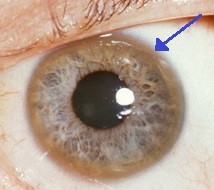
© Herbert L et al, CC BT 3.0, via Wikimedia Commons
Other Wilson's disease features
Other features that may develop include:
אנמיה.
נזק לכליות.
Heart problems.
Inflammation of the pancreas (pancreatitis).
Menstrual problems.
Repeated miscarriage in women.
Premature 'thinning' of the bones (osteoporosis).
How is Wilson's disease diagnosed?
If Wilson's disease is suspected, it can be diagnosed by various tests:
A blood test to measure caeruloplasmin. This is a protein that binds copper in the bloodstream. The level is low in nearly all people with Wilson's disease.
Other blood tests may also be performed. These may be done to measure the copper levels and to test kidney and liver function.
A specialist may arrange a urine test to measure the amount of copper in the urine over a 24-hour period. The amount is typically higher than normal.
An examination of the layer at the front of the eye (called the cornea) by an optician (optometrist) or an eye specialist may show the Kayser-Fleischer rings if they have developed. (They are not present in all cases.)
A small sample (biopsy) of the liver may be taken to look at under the microscope. This can show the excess copper in the liver and the extent of any scarring of the liver (cirrhosis). See the separate leaflet called Liver biopsy for more details.
Other tests may also be advised - for example, a סריקת דימות תהודה מגנטית (MRI).
If Wilson's disease is confirmed then siblings should be checked to see if they have the condition. Brothers and sisters of a person with Wilson's disease have a 1 in 4 chance of also having the condition.
Wilson's disease treatment
It is essential to treat Wilson's disease as, without treatment, it can be fatal. The earlier treatment is started, the better the chance of preventing long-term permanent damage to the liver or brain. There is no cure for Wilson's disease but treatment reduces the risks of complications.
Penicillamine is a medicine called a chelating agent and is used to remove copper from the body. The penicillamine causes the excess copper from the body to be passed out in the urine. The dose may be reduced to a maintenance dose after about a year when the initial build-up of copper has been cleared. Unfortunately, the symptoms of Wilson's disease can deteriorate as a side effect of the medication.
Trientine is an alternative to penicillamine. It too is a chelating agent and removes copper from the body. It has slightly fewer side effects.
Zinc is an option in certain circumstances. Zinc works by blocking the gut from absorbing copper from food. Therefore, it does not clear excess copper from the body, but prevents any further build-up of copper. Zinc is much less likely than penicillamine or trientine to cause side-effects. It may be an option for people who are diagnosed at the very early stages of the disease and have no symptoms. Also, a switch to zinc may be an option for people who have been initially treated with penicillamine or trientine once the initial build-up of copper has been cleared from the body. Zinc may also be taken by pregnant women.
Note: treatment is needed for life. First, it is used to clear the excess copper and then to prevent future accumulation of copper. Failure to take medication can lead to a return to a build-up of copper, which can be serious - even fatal.
For the few people who do not respond to treatment with medication, or are diagnosed in the late stage of the disease with severe scarring of the liver (cirrhosis) or liver failure, a liver transplant may be an option. This can be life-saving. The long-term outlook after a liver transplant is usually very good.
דיאטה
Foods with a high concentration of copper generally should be avoided, at least in the first year of treatment when the excess copper is being cleared from the body. These include liver, chocolate, nuts, mushrooms and shellfish, especially lobster.
Complications of Wilson's disease
If treatment is begun in the early stages of the disease, it usually works very well. A normal length and quality of life can be expected.
However, without any treatment, Wilson's disease is usually fatal - typically before the age of 40.
If symptoms have developed before treatment has started, some of the symptoms improve with treatment but some may remain permanently. For example, some of the brain symptoms are permanent once they develop. A specialist will be able advise about which symptoms may go and which may be permanent, once treatment begins.
בחירות המטופלים עבור Genetic conditions
בריאות ילדים
תסמונת דאון
תסמונת דאון (המוכרת גם כתסמונת דאון) היא בעיה גנטית בכרומוזומים. לאדם עם תסמונת דאון יש עותק נוסף של כרומוזום 21 בתאי גופו. זה גורם לתכונות האופייניות של המצב. כל האנשים עם תסמונת דאון יש להם מידה מסוימת של לקות למידה. הם גם נמצאים בסיכון מוגבר לבעיות רפואיות שונות אחרות. תסמונת דאון עשויה להתגלות לפני הלידה (פרה-נטלית) או לאחר הלידה (פוסט-נטלית). לא ניתן לרפא אותה, אך טיפול ותמיכה יכולים לעזור לאדם עם תסמונת דאון לחיות חיים פעילים. קיימות מספר קבוצות ייעוץ ותמיכה לאנשים עם תסמונת דאון ולמשפחותיהם ומטפליהם, כמו עמותת תסמונת דאון (ראו קריאה נוספת למטה לקישור לאתר).
מאת ד"ר קולין טיידי, MRCGP
בריאות ילדים
הפרעות אגירת גליקוגן
Glycogen storage disorders are a group of inherited diseases. They result from a problem with one of the proteins (known as enzymes) involved in the conversion of glucose to glycogen, or the breakdown of glycogen back into glucose. They mostly tend to affect your liver and muscles. Most are diagnosed in childhood. Symptoms include weakness, tiredness and low blood sugar levels. Newer treatment possibilities provide hope for an improved outlook (prognosis). Most people with a glycogen storage disorder respond well to treatment. However, type II (infantile Pompe's disease) can be difficult to treat and can affect life expectancy.
by Dr Roger Henderson, MBBS
שאלות נפוצות
אם אני נשא של הגן למחלת וילסון, האם אני עדיין יכול להעביר אותו גם אם אין לי את המחלה?
כן, אם אתה יורש רק עותק אחד של הגן הלא תקין, אתה נחשב נשא. נשאים לא מפתחים בעצמם את מחלת וילסון מכיוון שיש להם גן תקין אחד שמספיק לשלוט בתפקוד הנחושת. עם זאת, נשאים יכולים להעביר את הגן הלא תקין לילדיהם.
מה הסבירות שלילד יהיה מחלת וילסון אם שני ההורים נשאים?
אם שני ההורים הם נשאים של הגן ATP7B הלא תקין, יש סיכוי של 1 ל-4 שהילד שלהם יירש שני גנים לא תקינים ולכן יפתח את מחלת וילסון. יש גם סיכוי של 2 ל-4 שהילד יהיה נשא וסיכוי של 1 ל-4 שהילד לא יהיה חולה במחלת וילסון ולא יהיה נשא.
מה קורה אם לא עוקבים באופן עקבי אחרי הטיפול במחלת וילסון?
הטיפול במחלת וילסון נדרש לכל החיים. בתחילה, הוא מסלק עודפי נחושת, ולאחר מכן מונע הצטברות עתידית. אי נטילת התרופה עלולה להוביל לחזרת הצטברות הנחושת, מה שיכול להיות חמור ואף קטלני.
אילו מזונות ספציפיים יש להגביל או להימנע מהם אם יש לי מחלת וילסון?
מזונות עם ריכוז גבוה של נחושת יש להימנע מהם בדרך כלל, במיוחד במהלך השנה הראשונה של הטיפול כאשר עודף הנחושת מתנקה מהגוף. אלה כוללים כבד, שוקולד, אגוזים, פטריות ופירות ים, במיוחד לובסטר.
מה התחזית לטווח הארוך עבור מישהו שעבר השתלת כבד עקב מחלת וילסון?
עבור המעטים שאינם מגיבים לטיפול תרופתי או מאובחנים מאוחר עם נזק חמור לכבד או כשל בכבד, השתלת כבד יכולה להיות אפשרות מצילת חיים. התחזית לטווח הארוך לאחר השתלת כבד היא בדרך כלל טובה מאוד.
קריאה נוספת והפניות
- British Liver Trust
- Wilson Disease; תורשה מנדלית מקוונת באדם (OMIM)
- EASL Clinical Practice Guidelines: Wilson's disease. J Hepatol. 2012 Mar;56(3):671-85. doi: 10.1016/j.jhep.2011.11.007.
- Children's Liver Disease Foundation
- Wilson's Disease Support Group UK
- Purchase R; The treatment of Wilson's disease, a rare genetic disorder of copper metabolism. Sci Prog. 2013;96(Pt 1):19-32.
- Aggarwal A, Bhatt M; Update on Wilson disease. Int Rev Neurobiol. 2013;110:313-48. doi: 10.1016/B978-0-12-410502-7.00014-4.
- Bandmann O, Weiss KH, Kaler SG; Wilson's disease and other neurological copper disorders. Lancet Neurol. 2015 Jan;14(1):103-13. doi: 10.1016/S1474-4422(14)70190-5.
אודות המחברצפה בפרופיל המלא

Dr Philippa Vincent, MRCGP
רופא כללי, מחבר רפואי
MB BS, Bsc, MRCGP (2000), DCH, DFSRH, DRCOG
ד"ר Philippa וינסנט הוא רופא משפחה ב-NHS העובד בצפון לונדון.
אודות המבקרצפה בפרופיל המלא

Dr Doug McKechnie, MRCGP
כותב רפואי
MA, MBBS, MSc, DRCOG, MRCP(UK), MRCGP(2021), FHEA
ד"ר דאג מקקני הוא רופא משפחה ב-NHS העובד בלונדון. הוא עובד במשרה מלאה קלינית ומשמש גם כסגן ראש המודול לפרקטיקה קלינית ומקצועית בבית הספר לרפואה של יוניברסיטי קולג' לונדון.
היסטוריית המאמר
המידע בעמוד זה נכתב ונבדק על ידי קלינאים מוסמכים.
המאמר זמין גם ב אנגלית, גרמנית, ספרדית, צרפתית, איטלקית, פורטוגזית, הינדי, עברית, ערבית, and שוודית.
הסקירה הבאה מתוכננת ל: 19 ינואר 2028
20 ינואר 2025 | הגרסה האחרונה

שאלו, שתפו, התחברו.
עיין בדיונים, שאל שאלות ושתף חוויות במאות נושאים בריאותיים.

מרגיש לא טוב?
הערך את הסימפטומים שלך באינטרנט בחינם
הירשמו לניוזלטר של פיישנט
המנה השבועית שלך של עצות בריאות ברורות ואמינות - נכתבה כדי לעזור לך להרגיש מעודכן, בטוח ובשליטה.
על ידי הרשמה אתה מקבל את שלנו מדיניות הפרטיות שלנו. באפשרותך לבטל את המנוי בכל עת. לעולם לא נמכור את הנתונים שלך.
עוד בבריאות ילדים
- גמילה בהובלת התינוק
- האכלת התינוק בבקבוק
- הנקה של תינוקך
- בריונות
- שפה וחך שסועים
- קוליק בתינוקות ופעוטות
- אקזמה בילדים
- חום אצל ילדים
- מחלת הירשפרונג
- הידרוצלה בתינוקות
- ברכיים פונות פנימה
- דלקת קרום המוח
- דלקת בלוטות הלימפה המזנטריות
- נמק מעי נמקי
- חיסון פנאומוקוקלי
- תסמינים של אלח דם בילדים
- חסימת דרכי דמעות בתינוקות
- טטנוס וחיסון הטטנוס
- תסמונת טרנר
- אשכים שלא ירדו