הפרעת מפרק הלסת (TMD)
נבדק על ידי Dr Toni Hazell, FRCGPעודכן לאחרונה על ידי ד"ר רוזלין אדלמן, MRCGPעודכן לאחרונה 18 נובמבר 2024
עומד בהנחיות העריכה של Patient
- הורדהורד
- שתף
- Language
- דיון
- גרסת שמע
- הוסף למקורות מועדפים בגוגל
הפרעות במפרק הלסת הן בעיות המשפיעות על מפרק הלסת ועל השרירים ורקמות אחרות סביב מפרק הלסת. הפרעות אלו בדרך כלל גורמות לכאב או להפחתת תנועת הלסת, ולעיתים לצלילים כמו קליקים או חריקות של מפרק הלסת. ישנן סיבות שונות להפרעות אלו, אך בדרך כלל הן אינן חמורות ומשתפרות לעיתים קרובות עם טיפולים פשוטים.
במבט חטוף
הפרעות במפרק הלסת (TMDs) הן בעיות המשפיעות על מפרק הלסת שלך.
Symptoms include pain near the ear, reduced jaw movement, and clicking sounds.
הפרעות במפרק הלסת יכולות להיגרם ממתח בשרירים, שימוש יתר בלסת, או בעיות בתוך המפרק עצמו.
רוב הפרעות ה-TMD משתפרות עם טיפולים פשוטים כמו משככי כאבים, מנוחה ותרגילי לסת.
אם אתה חושב שיש לך TMD, כדאי שתפנה לרופא השיניים שלך לייעוץ.
What are temporomandibular disorders?
Temporomandibular disorders (TMDs) are problems which affect the jaw joint.
The jaw joint is located just in front of the ear, and it joins the jaw bone (mandible) to the skull near to the temple. The jaw joint is also called the 'temporomandibular joint'. Problems affecting this joint itself are usually known as TMJ disorders. However, there are various other causes of jaw pain and so the various conditions affecting the joint are now called 'temporomandibular disorders (TMDs)'.
TMJ dysfunction
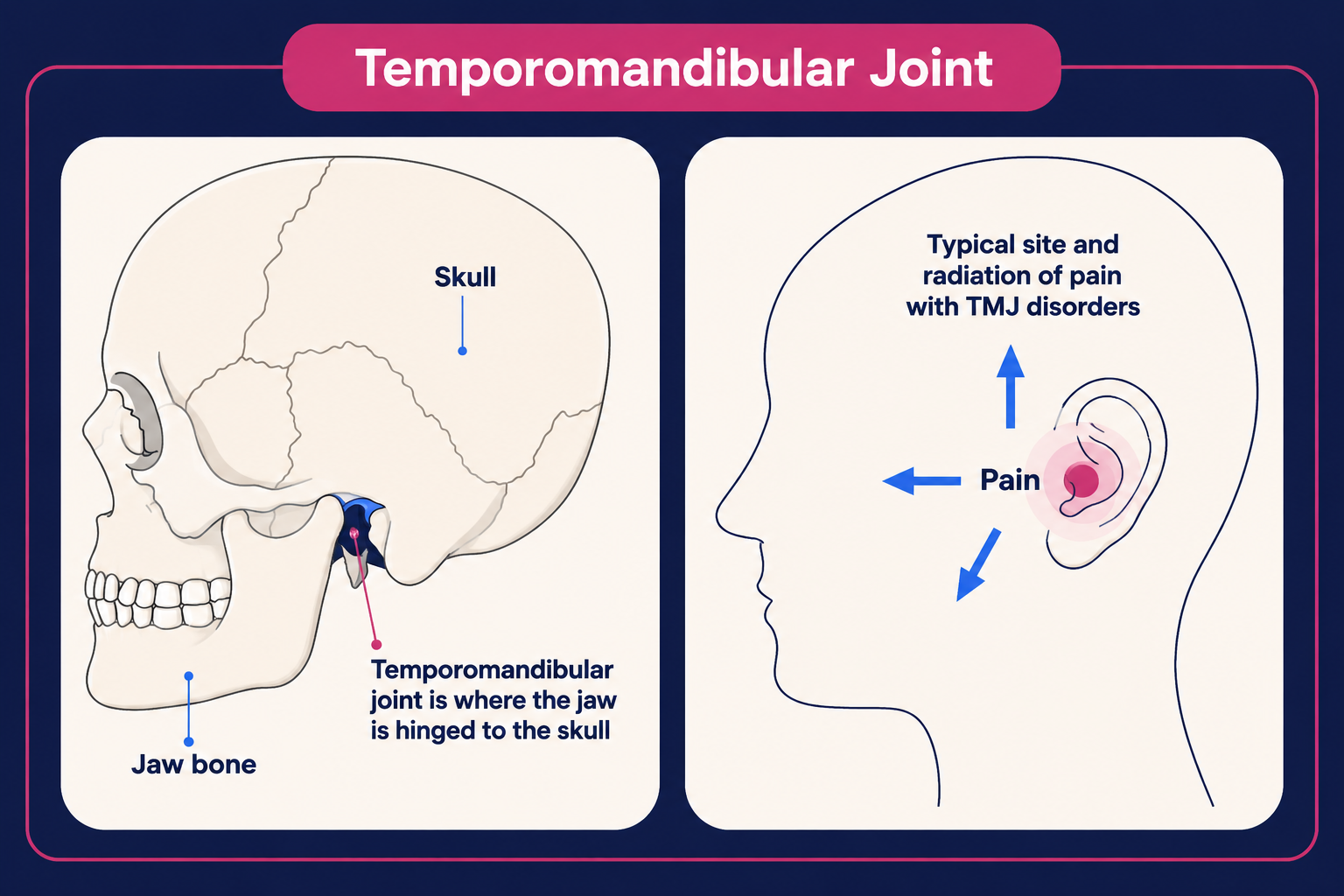
Understanding the jaw joint
A joint is the place where two bones meet. Joints allow movement and flexibility between two bones. The jaw joint allows movement between the jawbone (mandible) and the skull. Muscles attached to the skull and jawbone cause the jawbone to move as the mouth is opened and closed.
Inside the jaw joint, there is a smooth material called cartilage, covering part of the bones. There is also a cartilage disc within the joint. The joint is lubricated by fluid called synovial fluid.
The muscles used for chewing (mastication) are mainly responsible for movement of the jaw.
Symptoms of TMD
Pain in the joint area or nearby. The pain is usually located just in front of the ear and it may spread to the cheek, the ear itself and the temple.
Jaw movements may be reduced. This may be a general tight feeling or a sensation of the jaw getting stuck. Very rarely, the jaw may become 'locked', causing difficulty in opening or closing the mouth.
Clicks or noises can sometimes be heard coming from the jaw joint when you chew or move your mouth. These noises can be normal, so they are only relevant if you have other symptoms in the joint, such as pain or reduced movement.
Because the ear is very close to the jaw joint, some people develop ear symptoms such as:
Noise in the ear.
Sensitivity to sound.
Dizziness (vertigo).
TMD treatment
Most problems in the jaw joint can be helped with simple treatments such as painkillers and advice on how to rest the joint. If you think you have TMD see your dentist for advice. There are various treatments which are often used in combination:
Resting the jaw joint
At rest, try to keep your teeth slightly apart and your tongue resting in the bottom of your mouth.
You can rest the joint by eating soft food and not using chewing gum.
Also, avoid opening the mouth very wide - so don't do too much singing and try not to yawn too widely.
Massaging the muscles and applying warmth can help.
Improving posture can help - for instance, when sitting in front of a computer for a long time.
Other treatments are relaxation and stress-reducing therapies - presumably because people tend to clench their jaw when they are stressed, or because stress makes pain worse.
Splints or bite guards are sometimes suggested. These cover the teeth at night to reduce clenching of the jaw and can be made by dentists. There is no definite evidence from research trials that they work but some people find them helpful.
תרופות
משככי כאבים כגון פרצטמול, איבופרופן או קודאין can help. If these are not enough, muscle relaxants or a small dose of a medicine called a tricyclic antidepressant or a medicine called gabapentin can give added pain relief.
פיזיותרפיה
Physiotherapy treatments, such as ultrasound and gentle jaw exercises, can be helpful.
Exercises for jaw pain:
Before you start, warm the jaw area up with a hot water bottle or wheatbag. This will help the muscles to move more easily.
Place your fingers on the front of your chin and try to move the lower jaw forward against the resistance of your fingers. Hold this position for a few seconds, then relax. Repeat three times.
Place your fingers under your chin and try to open your jaw against resistance. Hold this position for a few seconds, then relax. Repeat three times.
Place your fingers on one side of your lower jaw and try to move your lower jaw sideways against the resistance of your fingers. Hold this position for a few seconds, then relax. Repeat three times. Then do the same on the other side.
Place your fingers over the jaw joint and gently open your mouth as far as you can. Take care that your jaw opens straight and not to one side.
You can repeat these exercises several times a day until the symptoms ease.
Treatment of other conditions
If there is an underlying condition - for example, a type of arthritis which is contributing to the TMD - this may need treating in its own right.
Injections or surgery
An injection of a medicine called a בסטרואידים into the joint may help, when symptoms are due to inflammation in the joint.
If the jaw muscles are overactive to a severe degree (such as with a movement disorder), an injection of botulinum toxin (Botox®) can reduce symptoms. There is debate about how effective this treatment is.
Inserting a fibre-optic device (arthroscopy) can be used for some types of treatment or surgery to the joint.
For a very few patients, surgical repair of the joint may be suggested. Various operations can be done, depending on the individual situation.
טיפולים אחרים
Some other treatments have been tried and may be available in some areas. These treatments include kinesio taping and acupuncture.
How common are temporomandibular disorders?
TMDs are fairly common. About 1 in 4 people have symptoms in the jaw joint at some time in their lives. Of these people, only about 1 in 20 consult a doctor for this problem.
What causes temporomandibular disorders?
In general, TMDs are thought to have a 'multifactorial' cause, meaning that there are usually a number of factors contributing to the cause. These factors can be grouped into two types:
Problems linked to the muscles working the joint.
Problems inside the joint itself.
The muscle problems are the most common type, particularly for younger people.
Problems with the muscles may be caused by:
Tension of the jaw muscles. This can occur if you clench your jaw a lot during sleep, which is quite common. Some people also clench their jaw during the day if they are feeling tense or anxious.
Overuse of the jaw muscles, such as habitually chewing gum, or biting nails.
Rarely, other conditions make the jaw muscles overactive. For example, there are some rare kinds of movement disorders (called orofacial dystonias) which cause excessive jaw clenching.
Increased sensitivity to pain. We don't know why this happens but it may be linked to stress, or to some other process which affects pain sensitivity. Some doctors call this type of problem a pain syndrome because the exact cause of the pain is not known.
Problems in the joint may be caused by:
Wear and tear to the inside of the joint - for example, wear and tear to the cartilage. Sometimes this is due to a type of arthritis called אוסטיאוארתריטיס. This problem tends to affect older rather than younger people.
Certain other types of arthritis. Arthritis means inflammation in a joint. There are different kinds of arthritis. For example, דלקת מפרקים שגרונית ו שיגדון are both types of arthritis which may affect various joints in the body and they can sometimes affect the jaw joint.
Injury to the TMJ or to its cartilage disc can cause TMJ pain.
How are temporomandibular disorders diagnosed?
Often, the diagnosis is made on the basis of your symptoms and a dentist or doctor's examination. In many cases, no tests are necessary if you are healthy and have symptoms that are typical of a TMD. if your symptoms don't settle with simple advice and treatment then you may be referred to specialist for tests and further treatment. Possible tests are:
בדיקות דם which may be helpful to look for signs of inflammation, or to rule out other causes of pain in that area.
קרני רנטגן may be used to assess your teeth and to look for any fractures, joint dislocations, or severe wear and tear (degeneration) of the jaw joint.
An MRI scan או סריקת CT can be used to give a detailed picture of the joint.
Use of a fibre-optic device (arthroscopy) to look inside the joint. This may be used if other tests do not show the cause of the pain.
מה התחזית (פרוגנוזה)?
Generally the outlook is good. Most TMDs improve over time and do not become worse. It is very rare to have any complications with this condition. Some people do have symptoms that last longer or come back (recur). However, even these can usually be improved with the treatments described above. Most people do not need injections or surgery and will get better with simple treatments and time.
בחירות המטופלים עבור כאב מפרקים

עצמות, מפרקים ושרירים
כתף קפואה
כתף קפואה (במונחים רפואיים, קפסוליטיס דביק של הכתף) היא מצב שבו הכתף הופכת לכואבת ונוקשה, לעיתים קרובות ללא סיבה מסוימת. תנועות הכתף מצטמצמות, לפעמים עד כדי 'קיפאון' מוחלט. בדרך כלל זה משפיע רק על כתף אחת אך יכול להשפיע על שתיהן. סבורים שזה נובע מהיווצרות רקמה דמוית צלקת בקפסולת הכתף. ללא טיפול, התסמינים בדרך כלל נעלמים אך זה יכול לקחת זמן רב, עד שלוש שנים במקרים מסוימים. טיפולים שונים עשויים להקל על הכאב ולשפר את תנועת הכתף שלך.
מאת ד"ר פיליפה וינסנט, MRCGP
עצמות, מפרקים ושרירים
פציעות והפרעות בשרוול המסובב
Rotator cuff injuries and disorders are the most common causes of shoulder pain. There are three common conditions that can affect the rotator cuff: rotator cuff tears, subacromial impingement and calcific tendonitis. Most people with rotator cuff problems can be successfully treated by a combination of exercises (avoiding overhead activities), painkillers, physiotherapy and occasionally steroid injections. Surgery is sometimes an option.
מאת ד"ר פיליפה וינסנט, MRCGP
שאלות נפוצות
מהו זמן ההחלמה הטיפוסי להפרעות במפרק הלסת (TMDs)?
רוב הפרעות ה-TMD משתפרות עם הזמן. התחזית בדרך כלל טובה, ונדיר שהמצב מחמיר או גורם לסיבוכים. גם אם התסמינים נמשכים זמן רב יותר או חוזרים, ניתן בדרך כלל לנהל אותם ביעילות עם טיפולים שונים.
האם מתח או חרדה יכולים לתרום להפרעות במפרק הלסת?
כן, מתח וחרדה נחשבים כגורמים תורמים להפרעות במפרק הלסת (TMDs). אנשים לעיתים קרובות מהדקים את הלסת כשהם מרגישים מתוחים או חרדים, מה שיכול להוביל לבעיות בשרירים סביב מפרק הלסת. מתח יכול גם להגדיל את הרגישות לכאב, ולהחמיר את התסמינים.
האם יש שינויים באורח החיים שאני יכול לעשות כדי לעזור בניהול תסמיני TMD?
כן, מספר התאמות באורח החיים יכולות לעזור. אלו כוללות אכילת מזונות רכים, הימנעות מלעיסת מסטיק, ואי פתיחת הפה יתר על המידה (למשל, בזמן פיהוק או שירה בקול רם). שיפור היציבה, במיוחד אם אתם יושבים מול מחשב לפרקי זמן ארוכים, יכול גם להיות מועיל. מומלץ גם על טיפולי הרפיה והפחתת מתח, שכן מתח יכול להחמיר את הידוק הלסת והכאב.
האם כאבי הראש שלי יכולים להיות קשורים להפרעה במפרק הלסת?
למרות שהמאמר לא מזכיר במפורש כאבי ראש כסימפטום ישיר, הכאב מ-TMD ממוקם לעיתים קרובות מול האוזן ויכול להתפשט לרקה. בהתחשב בקרבה ובקישוריות של המבנים, סביר להניח שכאב שמקורו במפרק הלסת יכול להיתפס ככאב ראש באזור זה.
קריאה נוספת והפניות
- Buescher JJ; Temporomandibular joint disorders. Am Fam Physician. 2007 Nov 15;76(10):1477-82.
- Coskun Benlidayi I, Salimov F, Kurkcu M, et al; Kinesio Taping for temporomandibular disorders: Single-blind, randomized, controlled trial of effectiveness. J Back Musculoskelet Rehabil. 2016 Feb 19.
- Pihut M, Ferendiuk E, Szewczyk M, et al; The efficiency of botulinum toxin type A for the treatment of masseter muscle pain in patients with temporomandibular joint dysfunction and tension-type headache. J Headache Pain. 2016 Dec;17(1):29. doi: 10.1186/s10194-016-0621-1. Epub 2016 Mar 24.
- Temporomandibular disorders (TMDs); NICE CKS, מאי 2024 (גישה בבריטניה בלבד)
- Ghurye S, McMillan R; Orofacial pain - an update on diagnosis and management. Br Dent J. 2017 Dec;223(9):639-647. doi: 10.1038/sj.bdj.2017.879. Epub 2017 Oct 27.
אודות המחברצפה בפרופיל המלא

ד"ר רוזלין אדלמן, MRCGP
MRCGP
ד"ר רוזלין אדלמן, היא רופאת משפחה ב-NHS העובדת בצפון לונדון.
אודות המבקרצפה בפרופיל המלא

Dr Toni Hazell, FRCGP
MBBS, BSc, FRCGP, DFSRH, Dip GU med, DRCOG, DCH (London, UK, 2000)
ד"ר טוני הייזל סיימה את לימודיה בבית הספר לרפואה של בית החולים סנט מרי ועשתה את התמחותה בבית החולים נורת'וויק פארק.
היסטוריית המאמר
המידע בעמוד זה נכתב ונבדק על ידי קלינאים מוסמכים.
המאמר זמין גם ב אנגלית, גרמנית, ספרדית, צרפתית, איטלקית, פורטוגזית, הינדי, עברית, ערבית, and שוודית.
הסקירה הבאה מתוכננת ל: 17 נובמבר 2027
18 נובמבר 2024 | הגרסה האחרונה

שאלו, שתפו, התחברו.
עיין בדיונים, שאל שאלות ושתף חוויות במאות נושאים בריאותיים.

מרגיש לא טוב?
הערך את הסימפטומים שלך באינטרנט בחינם
הירשמו לניוזלטר של פיישנט
המנה השבועית שלך של עצות בריאות ברורות ואמינות - נכתבה כדי לעזור לך להרגיש מעודכן, בטוח ובשליטה.
על ידי הרשמה אתה מקבל את שלנו מדיניות הפרטיות שלנו. באפשרותך לבטל את המנוי בכל עת. לעולם לא נמכור את הנתונים שלך.
עוד בעצמות, מפרקים ושרירים
- כאבי גב ועמוד שדרה
- כאבי גב אצל ילדים
- תסמונת זנב הסוס
- ספונדילוזיס צווארי
- התכווצות דופויטרן
- מתיחת מפשעה
- הפרעות ספקטרום היפרמוביליות
- התכווצויות ברגליים
- שברים בעצמות המסרק
- אוסטאומיאליטיס
- אוסטאופורוזיס
- מחלת פאג'ט של העצם
- מניעת אוסטאופורוזיס הנגרמת על ידי סטרואידים
- החלמה משבר באגן
- פציעות והפרעות בשרוול המסובב
- היצרות תעלת השדרה
- פציעות ספורט
- כאב גב תורקלי
- טורטיקוליס
- אצבע הדק