Cystoscopy
Peer reviewed by Dr Colin Tidy, MRCGPLast updated by Dr Philippa Vincent, MRCGPLast updated 10 Aug 2023
Meets Patient’s editorial guidelines
- DownloadDownload
- Share
- Language
- Discussion
- Audio Version
- Add to preferred sources on Google
A cystoscopy is a procedure which looks into the bladder with a special telescope called a cystoscope.
Note: the information below is a general guide only. The arrangements, and the way tests are performed, may vary between different hospitals. Always follow the instructions given by your doctor or local hospital.
At a glance
A cystoscopy uses a thin telescope to examine the bladder via the urethra.
It helps diagnose frequent UTIs, blood in urine, incontinence, and painful urination.
It can also be used to treat conditions like bladder stones or remove bladder tumours.
The procedure usually takes 5-10 minutes and is often done whilst you are awake.
Afterwards, you might feel a mild burning sensation when urinating.
Seek medical help if pain or bleeding is severe or lasts longer than two days.
Also, seek help if you develop a fever or other symptoms of infection.
Why is a cystoscopy done?
To help with diagnosis
A cystoscopy may be done to help to find the cause of symptoms such as:
Unusual cells found in a urine sample.
Persistent pain when passing urine.
Difficulty in passing urine - which may be due to prostate enlargement or a narrowing (stricture) of the urethra.
Cystoscopy may also be done to monitor progress of conditions. For example, some people have a routine cystoscopy every now and then after treatment for a bladder tumour. This helps to detect any early recurrence which can be treated before it spreads further.
To treat certain conditions, or to do certain procedures
By using various instruments which are passed down the side channels a doctor can:
Remove bladder stones. If a stone is lodged higher - in a ureter - the doctor may extend the cystoscope up into a ureter. The ureters are the tubes that drain urine from the kidneys to the bladder.
Remove small lumps (polyps) or tumours from the lining of the bladder.
Insert a small tube (stent) into a narrowed ureter. This helps the flow of urine if there is a narrowing.
Perform a special X-ray of the ureters and kidneys. A doctor can inject a dye into the ureters up towards the kidney. This shows up on X-ray pictures and helps to show problems of the kidney or ureter.
Remove the prostate gland (by using a special type of cystoscope which 'chips' away at the prostate gland bit by bit).
What is a cystoscope?
A cystoscope is a thin telescope which is passed into the bladder via the urethra, the tube that takes urine from the bladder to the outside of the body. There are two types. The cystoscope can be looked down but it also transmits pictures to a computer screen so they can be seen by other members of the team. Both types of cystoscope have side channels where various thin instruments can be passed down. For example a small sample (biopsy) may be taken from the bladder wall using an instrument which can pinch tissue and carry it back down the side channel.
Types of cystoscopy
A flexible cystoscope is the most commonly used. It is a thin, flexible, fibre-optic telescope which is about as thick as a pencil. As it is flexible, it passes easily along the curves of the urethra. The flexible tip can also be moved easily so that the whole of the bladder lining can be seen.
Flexible cystoscope
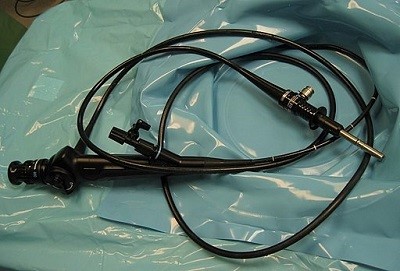
© By Michael Reeve, via Wikimedia Commons
A rigid cystoscope is a thin, solid, straight telescope. It allows a greater variety of devices to pass down the side channels so can be used for a wider variety of procedures.
Diagram of a rigid cystoscope and how a cystoscopy is performed
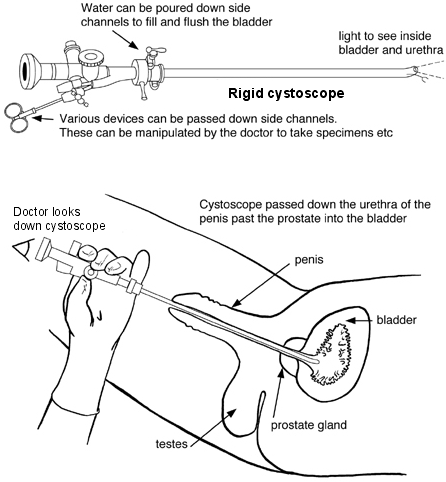
Cystoscopy procedure
Cystoscopy is usually done as an outpatient procedure. This means people go home the same day and aren't required to stay overnight. It is usually done whilst awake. Some people are given a sedative to help them to relax.
The opening to the urethra (at the end of the penis, or the outside of the vagina) and the nearby skin will be cleaned. Some 'jelly' is then squirted into the opening of the urethra. The jelly usually contains a local anaesthetic to numb the lining of the urethra. This helps the cystoscope to pass into the urethra with as little discomfort as possible.
Male and female cystoscopy
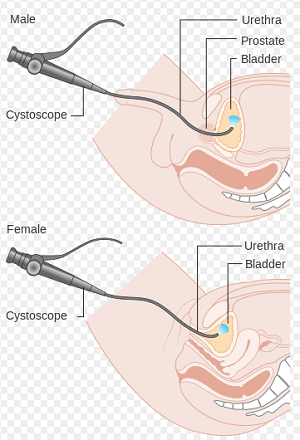
The cystoscope is then gently pushed up into the bladder and the lining of the urethra and bladder is carefully examined. Sterile water is passed down a side channel in the cystoscope to fill the bladder slowly. This makes it easier to see the lining of the bladder and the bladder wall. As the bladder fills it causes the feeling of a need to pass urine which may be uncomfortable.
The cystoscope is then gently pulled out. If a biopsy was taken, the sample would be sent away to be tested and looked at under a microscope. It can take several weeks for the report of the biopsy to come back to the doctor.
In some cases a general anaesthetic is given when a cystoscopy is done, particularly if a rigid cystoscope is used. In some cases a spinal anaesthetic is given which numbs all the lower half of the body.
How long does a cystoscopy take?
A cystoscopy takes about 5-10 minutes if it is just to look inside the bladder. It may last longer if a procedure is being performed - for example, taking a sample (biopsy) from the lining of the bladder.
Is a cystoscopy painful?
Cystoscopies are not usually painful, particularly as local anaesthetic is used to insert the cystoscope. They can be uncomfortable, especially when the bladder has been filled with water.
Complications of a cystoscopy
Most cystoscopies are done without any problem.
For the following 24 hours there may be a mild burning sensation when passing urine and a feeling of a need to pass urine more often than usual. The urine may also look pink due to mild bleeding, particularly if a biopsy was taken.
Occasionally, a urine infection develops shortly after a cystoscopy. This can cause a high temperature (fever) and pain on passing urine.
Rarely, the cystoscope may damage or perforate the bladder. After having a cystoscopy, medical advice should be sought if:
Pain or bleeding is severe.
Pain or bleeding lasts longer than two days.
Symptoms of infection develop, such as a fever.
Preparing for a cystoscopy
There are not usually any particular preparations needed before a flexible cystoscopy. Usually it is possible to eat and drink as normal beforehand. There is no need to empty the bladder. A rigid cystoscopy normally requires a general anaesthetic so guidance will be given about when to stop eating and drinking and what to do.
After a cystoscopy
After a flexible cystoscopy, it is usual to need to empty the bladder urgently and then to go home without any need for additional support. After a rigid cystoscopy, a catheter may be used to empty the bladder and the normal advice would be given about having a general anaesthetic (to wait in the hospital for a few hours to recover, to be unable to drive home, to need support at home for 24 hours).
Patient picks for Urine and bladder tests
Tests and investigations
Voiding cystourethrogram
A micturating/voiding cystourethrogram (MCUG/VCUG) produces X-ray images of the bladder and urinary tract. Note: the information below is a general guide only. The arrangements, and the way tests are performed, may vary between different hospitals. Always follow the instructions given by your doctor or local hospital.
by Dr Laurence Knott
Tests and investigations
Midstream specimen of urine
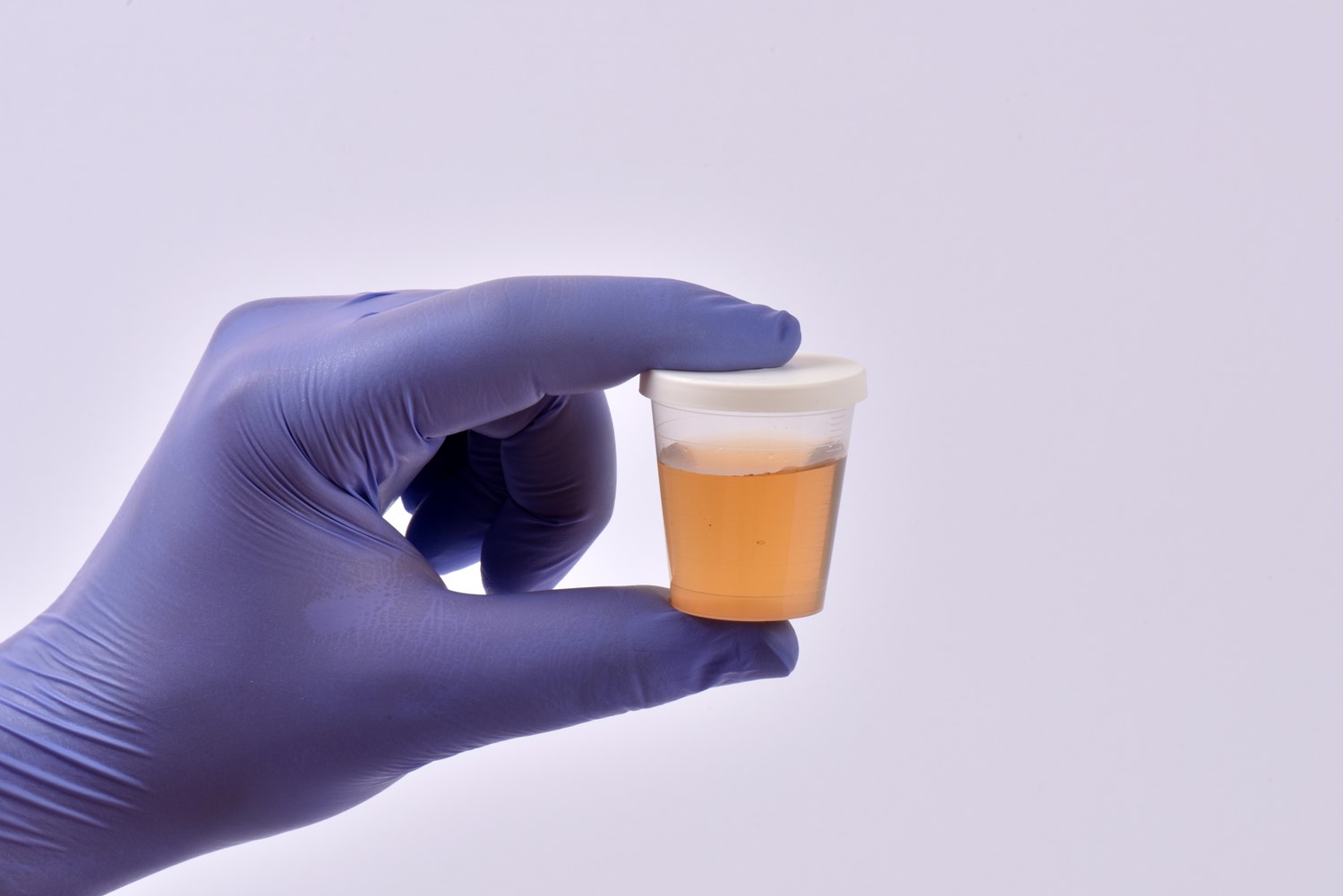
A midstream specimen of urine (MSU or MSSU) is usually tested to look for infection, although in some cases, illness other than infection might be diagnosed based partly on what is seen in an MSU.
by Dr Rachel Hudson, MRCGP
Frequently asked questions
What is a cystoscope used for?
A cystoscope is a thin telescope inserted into the bladder via the urethra. It helps doctors to look inside the bladder and urethra, and also has side channels through which various thin instruments can be passed to perform procedures like removing bladder stones or taking biopsies.
How long does a cystoscopy take?
A standard cystoscopy, if only for examination purposes, typically takes about 5-10 minutes. However, if additional procedures are carried out, such as taking a biopsy from the bladder lining or removing small stones, the duration will be longer.
Does a cystoscopy involve any special preparation?
Usually, no specific preparation is needed for a flexible cystoscopy; you can eat and drink as normal and don't need to empty your bladder beforehand. If a rigid cystoscopy is planned, which often involves a general anaesthetic, specific instructions will be provided regarding eating, drinking, and what to do.
What should I expect after a cystoscopy?
Following a flexible cystoscopy, you will likely feel an urgent need to empty your bladder before going home, and usually won't need further support. For a rigid cystoscopy, especially with a general anaesthetic, a catheter might be used, and you'll receive advice about recovering from anaesthesia, such as not driving and needing support at home for 24 hours.
When should I seek medical advice after a cystoscopy?
Although most cystoscopies are problem-free, you should seek medical advice if you experience severe pain or bleeding, or if pain or bleeding lasts for more than two days. You should also contact your doctor if you develop symptoms of an infection, such as a fever.
Further reading and references
- Zhang ZS, Wang XL, Xu CL, et al; Music reduces panic: an initial study of listening to preferred music improves male patient discomfort and anxiety during flexible cystoscopy. J Endourol. 2014 Jun;28(6):739-44. doi: 10.1089/end.2013.0705. Epub 2014 Mar 31.
- Gee JR, Waterman BJ, Jarrard DF, et al; Flexible and rigid cystoscopy in women. JSLS. 2009 Apr-Jun;13(2):135-8.
- Engelsgjerd JS, Deibert CM; Cystoscopy
- DeGeorge KC, Holt HR, Hodges SC; Bladder Cancer: Diagnosis and Treatment. Am Fam Physician. 2017 Oct 15;96(8):507-514.
About the authorView full bio

Dr Philippa Vincent, MRCGP
General Practitioner, Medical Author
MB BS, Bsc, MRCGP (2000), DCH, DFSRH, DRCOG
Dr Philippa Vincent is an NHS GP working in North London.
About the reviewerView full bio

Dr Colin Tidy, MRCGP
General Practitioner, Medical Author
MBBS, MRCGP, MRCP (Paediatrics), DCH
Dr Colin Tidy is an NHS Doctor, based in Oxfordshire.
Article history
The information on this page is written and peer reviewed by qualified clinicians.
Article also available in English, German, Spanish, French, Italian, Portuguese, Hindi, Hebrew, Arabic, and Swedish.
Next review due: 8 Aug 2028
10 Aug 2023 | Latest version
Join the conversation
Share your thoughts or experiences with others in our patient communities.

Ask, share, connect.
Browse discussions, ask questions, and share experiences across hundreds of health topics.

Feeling unwell?
Assess your symptoms online for free
Sign up to the Patient newsletter
Your weekly dose of clear, trustworthy health advice - written to help you feel informed, confident and in control.
By subscribing you accept our Privacy Policy. You can unsubscribe at any time. We never sell your data.
More in tests and investigations
- Barium tests
- Bowel cancer screening
- BRCA genes
- Bronchoscopy
- Cardiac catheterisation
- DEXA scan
- DMSA scan
- Electrocardiogram
- Endobronchial ultrasound-guided transbronchial needle aspiration
- Exercise Tolerance Testing
- Faecal immunochemical test
- Hysteroscopy
- Ketones in urine
- Newborn hearing test
- Newborn physical examinations
- Patch testing for contact dermatitis
- Sigmoidoscopy
- Sweat test
- Symptom checker
- Synacthen test