זיהום בדרכי השתן אצל אנשים מבוגרים
נבדק על ידי ד"ר רייצ'ל הדסון, MRCGPעודכן לאחרונה על ידי Dr Toni Hazell, FRCGPעודכן לאחרונה 14 נובמבר 2024
עומד בהנחיות העריכה של Patient
- הורדהורד
- שתף
- Language
- דיון
- גרסת שמע
- הוסף למקורות מועדפים בגוגל
If you have a urine infection, you have germs (bacteria) in your bladder, kidneys or the tubes of your urinary system. Urine infections, also called bladder infections, are more common in older people, and there is more likely to be an underlying cause.
במבט חטוף
A urinary tract infection (UTI) is caused by germs multiplying in the urine.
Lower UTIs affect the bladder and urethra, while upper UTIs affect the kidneys.
Symptoms can include painful or frequent urination, tummy pain, or cloudy urine.
Kidney infections may cause back pain, fever, and feeling sick.
In older people, confusion or feeling generally unwell can be symptoms.
Antibiotics usually treat UTIs, and pain can be eased with paracetamol or ibuprofen.
See a doctor promptly if symptoms worsen or do not improve after a few days.
How the urinary tract works
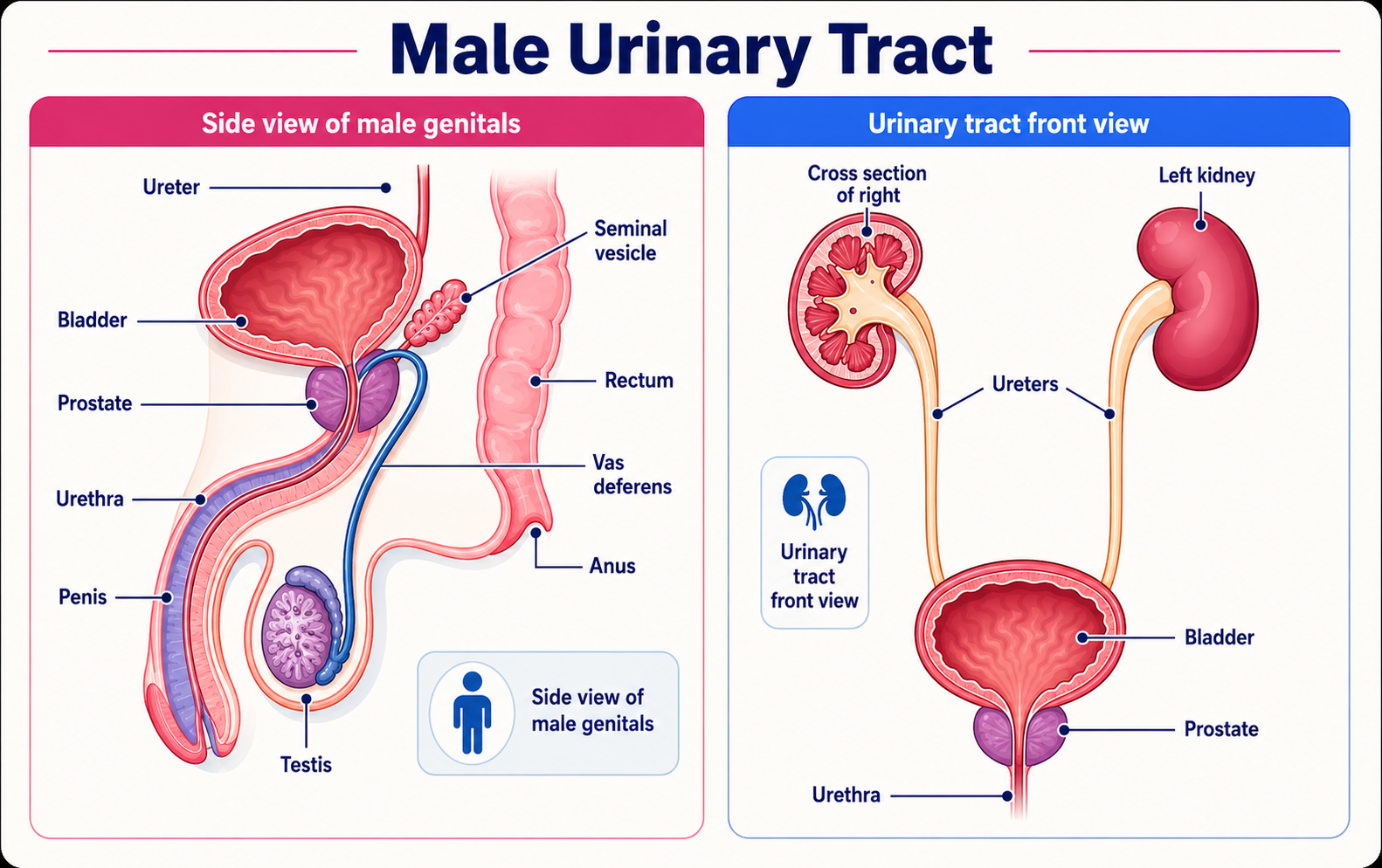
Urine is made by your two kidneys, one on each side of the tummy (abdomen). Urine drains down tubes called ureters into the bladder. There it is stored and passed out through a tube called the urethra, when you go to the toilet.
Male genitals side view and urinary tract cross-section diagram
Understanding urine infection
Most urine infections are caused by germs (bacteria) that come from your own bowel. They cause no harm in your bowel but can cause infection if they get into other parts of your body. Some bacteria lie around your back passage (anus) after you pass a stool. These bacteria sometimes travel up the tube called the urethra and into your bladder. Some bacteria thrive in urine and multiply quickly to cause infection.
A urine infection is often called a urinary tract infection (UTI) by healthcare professionals. When the infection is just in the bladder and urethra, this is called a lower UTI. If it travels up to affect one or both kidneys as well then it is called an upper UTI. This can be more serious than lower UTIs, as the kidneys can be damaged by the infection.
UTI causes
In many cases the infection occurs for no apparent reason. There is no problem with the bladder, kidney, prostate gland, or defence (immune) system that can be identified. In other cases, an underlying problem can increase the risk of developing a urine infection.
Urinary tract infection in older women
After the גיל המעבר the lining of tissues around your genital area may become more fragile. This is called atrophic vaginitis, or genitourinary syndrome of the menopause. It is associated with having more urine infections.
ה prolapse of the womb (uterus) or vagina can also increase your risk of infection.
In older men
א enlarged prostate gland may stop the bladder from emptying properly. Some urine may then pool in the bladder. Germs (bacteria) are more likely to multiply and cause infection in a stagnant pool of urine.
בשניהם
Bladder or kidney problems may lead to infections being more likely. For example, אבנים בכליות or conditions that cause urine to pool and not drain properly.
Having a thin, flexible, hollow tube (called a catheter) in place to drain urine.
An underlying health condition may also be responsible. A poor immune system increases the risk of having any infection, including urine infections. For example, if you are having כימותרפיה to treat cancer. Diabetes can also increase your risk of having urine infections.
Being constipated. If your lower gut (bowel) is full and swollen, it may press on the bladder. This may stop it emptying properly, making you more prone to urine infection.
Urinary tract infection symptoms in older people (seniors)
Infection in the bladder (cystitis):
Pain when you pass urine.
You pass urine more frequently.
You may have pain in your lower tummy (abdomen).
Your urine may become cloudy, bloody or offensive-smelling.
You may have a high temperature (fever).
Infection in the kidneys:
It may cause you to feel generally unwell.
There may be a pain in your back; this is usually around the side of the back (the loin), where each kidney is located.
You may have a high fever, which might feel like a chill or make you shake. You may feel sick, or be sick (vomit).
In some older people the only symptoms of the urine infection may be becoming confused or just feeling generally unwell.
The confusion is caused by a combination of factors such as having a fever and having a lack of fluid in the body (dehydration). The confusion should pass when the infection has been treated. An infection which is left untreated can lead to sepsis, which can be very serious, or to long-term kidney damage.
Treatment of UTI in elderly people (male and female)
A course of an תרופה אנטיביוטית will usually clear the infection quickly. You should see a doctor if your symptoms are not gone, or nearly gone, after a few days.
פרצטמול או איבופרופן will usually ease any pain, discomfort, or high temperature (fever).
An underlying cause such as an enlarged prostate gland או עצירות may be found and need treatment.
It is helpful to drink plenty of water.
שאלות נפוצות
How common are urine infections?
Urine infections are much more common in women than in men. This is because in women the urethra - the tube from the bladder that passes out urine - is shorter. Also it opens nearer the back passage (anus) than in men. Half of all women will have a urine infection that needs treating in their lifetime.
Urine infections are less common in men. They are very uncommon in young and middle-aged men. They are more common in older men. Men who have to use a urinary catheter are at higher risk of a UTI. A catheter is a thin, flexible, hollow tube used to drain urine. Older men are more likely to need a catheter because of prostate problems, which become more common with age.
Urine infections tend to become more common as you get older.
האם יש צורך בבדיקות כלשהן?
In some cases the diagnosis may be obvious and no tests are needed. For a woman who is aged under 65 and is not pregnant, it would be reasonable for a GP to provide antibiotics on the basis of a phone call with appropriate symptoms, though this might not be done if it was a second UTI in a short period of time. A test on a urine sample is sometimes used to confirm the diagnosis and identify what germ (bacterium) is causing the infection. Sometimes a dipstick test can provide enough information immediately. In other cases the urine sample is sent to a laboratory for further examination under a microscope. This result takes several days.
Further tests are not usually necessary if you are otherwise well and have a one-off infection. However, your doctor may advise tests of your kidney or bladder if an underlying problem is suspected.
An underlying problem is more likely if the infection does not clear with antibiotic medication, or if you have:
Symptoms that suggest a kidney is infected (and not just the bladder).
Recurring urine infections (for example, two or more episodes in a three-month period).
Had problems with your kidney in the past, such as kidney stones or a damaged kidney.
Symptoms that suggest a blockage (an obstruction) to the flow of urine.
Relevant tests may include:
A blood test.
A scan of your kidneys or bladder, such as an בדיקת אולטרסאונד.
Tests to see how well your bladder is functioning, called urodynamic tests.
A look inside your bladder with a special telescope (cystoscopy).
מה התחזית (פרוגנוזה)?
Most people improve within a few days of starting treatment. See a doctor if you do not quickly improve. If your symptoms do not improve despite taking an antibiotic medicine then you may need an alternative antibiotic. This is because some bacteria are resistant to some types of antibiotics. This can be identified from tests done on your urine sample.
Can I prevent urine infections?
There are some measures which may help in some cases:
It makes sense to avoid constipation, by eating plenty of fibre (such as fruit) and drinking enough fluid.
Older women with atrophic vaginitis may wish to consider hormone replacement creams or pessaries. These have been shown to help prevent urine infections.
If there is an underlying medical problem, treatment for this may stop urine infections occurring.
For some people with repeated urine infections, a preventative low dose of antibiotic taken continuously may be prescribed.
Women should wipe themselves from front to back after opening their bowels, to avoid getting germs (bacteria) from the bowel into the bladder.
בחירות המטופלים עבור Urinary problems
בריאות הגבר
תסמינים של דרכי השתן התחתונות אצל גברים
Lower urinary tract symptoms (LUTS) are a very common problem, especially in men over the age of 65 years. They can be caused by various conditions. These symptoms may include slowing of the urine stream and needing to get up to pass urine at night. There are different causes of LUTS and the treatment will depend on the cause. Some men choose not to have treatment if their symptoms are not too bothersome and the cause is not serious.
מאת ד"ר פיליפה וינסנט, MRCGP

בריאות האישה
תסמינים בדרכי השתן התחתונות אצל נשים
תסמינים של דרכי השתן התחתונות (LUTS) נפוצים בקרב נשים בכל הגילאים, במיוחד בין הגילאים 40-60. עבור נשים רבות, התסמינים באים והולכים. אך עבור חלק מהנשים, התסמינים מתמשכים ומפריעים לחיים הרגילים. התסמינים עשויים לכלול הרטבה עצמית (אי שליטה), צורך להטיל שתן בתדירות גבוהה, או אי נוחות בעת הטלת שתן. תסמינים אלו ואחרים יכולים לגרום לאיכות חיים ירודה. נשים רבות לעולם לא מספרות לאף אחד על התסמינים שלהן. הרופא שלך עשוי להמליץ על בדיקות לחיפוש סיבה בסיסית. הפניה למומחה בדרך כלל אינה נדרשת. לעיתים קרובות, לא נמצאת סיבה בסיסית ספציפית. טיפול עשוי לעזור להקל על התסמינים.
מאת ד"ר רייצ'ל הדסון, MRCGP
שאלות נפוצות
What is the difference between an upper and lower urinary tract infection?
A lower urinary tract infection (UTI) occurs when the infection is confined to the bladder and urethra. If the infection spreads upwards to affect one or both kidneys, it is then referred to as an upper UTI. Upper UTIs are generally considered more serious than lower UTIs because they can potentially cause damage to the kidneys.
When should an older person with a suspected UTI seek medical attention promptly?
Older people should seek medical attention promptly for a suspected UTI, especially if they experience confusion, a general feeling of being unwell, or symptoms that suggest a kidney infection. An untreated infection can lead to serious complications like sepsis or long-term kidney damage.
Can dehydration contribute to confusion in older people with a urinary tract infection?
Yes, confusion in older people with a urinary tract infection can be caused by a combination of factors, including having a fever and a lack of fluid in the body (dehydration). This confusion should typically resolve once the infection has been successfully treated.
Can lifestyle changes, like diet, help prevent recurrent UTIs?
Yes, avoiding constipation can help prevent urine infections. Eating plenty of fibre, such as fruit, and drinking enough fluid are good ways to achieve this. Constipation can cause the bowel to press on the bladder, preventing it from emptying properly and increasing the risk of infection.
Is there a specific way women should wipe after using the toilet to help prevent UTIs?
Yes, women should wipe themselves from front to back after opening their bowels. This practice helps to prevent germs (bacteria) from the bowel from entering the bladder, thereby reducing the risk of a urinary tract infection.
קריאה נוספת והפניות
- Urological infections; European Association of Urology (2022 -updated 2024)
- זיהום בדרכי השתן (תחתון) - נשים; NICE CKS, פברואר 2025 (גישה בבריטניה בלבד)
- Urinary tract infection (lower) - men; NICE CKS, יולי 2022 (גישה בבריטניה בלבד)
אודות המחברצפה בפרופיל המלא

Dr Toni Hazell, FRCGP
MBBS, BSc, FRCGP, DFSRH, Dip GU med, DRCOG, DCH (London, UK, 2000)
ד"ר טוני הייזל סיימה את לימודיה בבית הספר לרפואה של בית החולים סנט מרי ועשתה את התמחותה בבית החולים נורת'וויק פארק.
אודות המבקרצפה בפרופיל המלא

ד"ר רייצ'ל הדסון, MRCGP
רופא כללי ומחבר רפואי
MBChB, MRCGP (2008), BSc (Medical Science), DFSRH, DRCOG, DCH
ד"ר רייצ'ל הדסון, היא רופאה כללית ב-NHS העובדת בצפון מערב אנגליה.
היסטוריית המאמר
המידע בעמוד זה נכתב ונבדק על ידי קלינאים מוסמכים.
המאמר זמין גם ב אנגלית, גרמנית, ספרדית, צרפתית, איטלקית, פורטוגזית, הינדי, עברית, ערבית, and שוודית.
Next review due: 13 Nov 2027
14 נובמבר 2024 | הגרסה האחרונה

שאלו, שתפו, התחברו.
עיין בדיונים, שאל שאלות ושתף חוויות במאות נושאים בריאותיים.

מרגיש לא טוב?
הערך את הסימפטומים שלך באינטרנט בחינם
הירשמו לניוזלטר של פיישנט
המנה השבועית שלך של עצות בריאות ברורות ואמינות - נכתבה כדי לעזור לך להרגיש מעודכן, בטוח ובשליטה.
על ידי הרשמה אתה מקבל את שלנו מדיניות הפרטיות שלנו. באפשרותך לבטל את המנוי בכל עת. לעולם לא נמכור את הנתונים שלך.
עוד בבריאות לגיל השלישי
- מחלת אלצהיימר
- תרופות ביולוגיות לדלקת מפרקים שגרונית
- פמפיגואיד שלפוחתי
- מחלות לב וכלי דם
- גורמים לאובדן זיכרון ודמנציה
- כונדרוקלצינוזיס
- מחלת כליות כרונית
- מחלת ריאות חסימתית כרונית
- תרופות אנטי-ראומטיות משנות מחלה
- שיגדון
- אובדן שמיעה אצל אנשים מבוגרים
- שבר בירך
- תרופות וטיפול בדמנציה
- טיפול פליאטיבי
- דלקת מפרקים שגרונית
- הגנה על מבוגרים
- סוכרת סוג 2
- אקזמה וריקוזית
- דליות