מרלגיה פארסטטיקה
נבדק על ידי Dr Colin Tidy, MRCGPעודכן לאחרונה על ידי ד"ר טוני הייזל, MRCGPLast updated 15 Sept 2023
עומד בהנחיות העריכה של Patient
- הורדהורד
- שתף
- Language
- דיון
- גרסת שמע
- Add to preferred sources on Google
Meralgia paraesthetica is a nerve (neurological) condition that causes pain in the outer thigh. It is caused by compression of a nerve called the lateral cutaneous nerve of the thigh. This nerve supplies feeling (sensation) to the outer thigh. In many cases, the cause is not known. Usually the condition improves with conservative (non-surgical) treatment - such as anti-inflammatories, painkillers or steroid injections.
At a glance
Meralgia paraesthetica is a nerve condition causing pain, numbness, or tingling in the upper outer thigh.
It is caused by the entrapment or compression of a nerve in the upper leg.
Symptoms are often worse with walking and standing, but relieved by lying down with the hip flexed.
Most cases have no identifiable cause, but obesity and pregnancy are risk factors.
Treatment often involves conservative methods like rest, weight loss, or painkillers.
במאמר זה:
Video picks for חולשה ותחושת נימול בגפיים
המשך לקרוא למטה
What is meralgia paraesthetica?
Meralgia paraesthetica is a nerve (neurological) condition that causes an area of skin over the upper outer thigh to become painful, numb or tingly.
Meralgia paraesthetica is known as a nerve entrapment syndrome. This means it is a collection of symptoms caused by a trapped or compressed nerve. The trapped nerve in question is called the lateral cutaneous nerve of the thigh (also known as the lateral femoral nerve).
Meralgia paraesthetica symptoms
חזרה לתוכןThe most common symptoms are burning pain or numbness in the upper thigh, on the outer side. Children and younger people may just have pain that limits normal activities.
Other symptoms include altered sensation of that part of the thigh, or tingling/pins and needles. Symptoms tend to be made worse by walking and standing but relieved by lying down with the hip flexed. (Hip flexion is movement of the leg towards your tummy (abdomen); this can be with your knee bent or straight - but on your back it is easiest to draw your bent knee up to your chest.)
Other reported symptoms include aching in the groin, pain in the buttocks and an area of skin that seems super-sensitive to heat and light touch (as opposed to firm pressure).
המשך לקרוא למטה
Meralgia paraesthetica causes
חזרה לתוכןMost cases have no identifiable cause.
Meralgia paraesthetica can, however, be caused by direct injury to the lateral cutaneous nerve of the thigh accidentally. For example:
A seat belt injury from a car accident.
Inadvertently, during medical or surgical procedures - for example, keyhole (laparoscopic) hernia repairs.
Various sports and physical activities can be associated with meralgia paraesthetica. These include gymnastics, baseball, soccer, bodybuilding and strenuous exercise.
Rarer causes include a neuroma. Neuromas are non-cancerous (benign) growths (tumours) on a nerve. Pelvic or intra-abdominal tumours (including cancerous ones) could also compress the nerve and cause this problem. This is rare.
Other possible causes include lying down for long periods of time in a curled-up position. סוכרת can affect nerves in general and, although it would be unusual simply to have this one nerve affected, the lateral cutaneous nerve of the thigh could potentially be damaged by diabetes.
What is the lateral cutaneous nerve of the thigh?
חזרה לתוכןMeralgia Paraesthetica
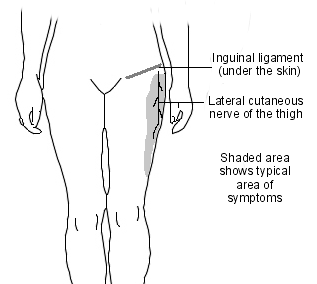
The lateral cutaneous nerve of the thigh is found in the upper leg. It provides sensation to an area of skin on the upper outer thigh. If this nerve is trapped or compressed, burning pain, numbness or tingling might be felt in the area of skin supplied by the nerve. These symptoms constitute meralgia paraesthetica.
The lateral cutaneous nerve of the thigh is a sensory nerve that supplies the skin. It starts off in the lower part of the spinal cord, in the lumbar region. It has to pass over the front of the hip bones and under the inguinal ligament before reaching the thigh. The inguinal ligament is a tough fibrous band in the groin. This is the site at which the nerve is most commonly compressed or trapped.
המשך לקרוא למטה
Who develops meralgia paraesthetica?
חזרה לתוכןAnyone can develop meralgia paraesthetica. It is more common in men than in women. Generally it occurs between the ages of 30-40 years. It is much rarer in children.
Risk factors include obesity, pregnancy and ascites. Ascites is the term used for a tense swelling of the tummy (abdomen) due to fluid.
How common is meralgia paraesthetica?
חזרה לתוכןMeralgia paraesthetica is a very uncommon condition. It most often affects people between the ages of 30-40 years. The condition is thought to be much rarer in children. It occurs more often in men than in women.
How is meralgia paraesthetica diagnosed?
חזרה לתוכןA doctor can make the diagnosis based on your symptoms and examination of your body. The diagnosis is likely to be suspected if you have typical pain or sensory symptoms affecting the upper outer thigh. The condition can, occasionally, affect both sides at the same time (about 1 in 5 cases).
Examination might show altered sensation in the area of skin supplied by the lateral cutaneous nerve of the thigh. The pain can usually be provoked by getting you to extend your hip. Hip extension is the movement of the leg backwards. The main buttock muscle (gluteus maximus) tightens when you make this movement.
Because the lateral cutaneous nerve of the thigh is a sensory nerve, it affects feeling and sensation. It does not affect movement of the leg or hip. Your doctor will check to see that there is no weakness of the muscles - if there is, the diagnosis is not meralgia paraesthetica.
Do I need any investigations?
חזרה לתוכןOften no investigations (such as blood tests, X-rays and scans) are needed for the diagnosis of meralgia paraesthetica. However, an בדיקת אולטרסאונד may be used if there is concern that a mass in the pelvis is causing the symptoms.
Further tests may be done if an underlying problem or alternative diagnosis is suspected. If you have meralgia paraesthetica arising from an accident or injury (such as a pelvic fracture) then other tests will be needed.
In some cases, nerve conduction tests are performed if surgery for meralgia paraesthetica is planned. Nerve conduction tests look at the electrical activity running through a nerve. This is adversely affected if a nerve is compressed or trapped.
Meralgia paraesthetica treatment
חזרה לתוכןTreatments can be grouped into conservative treatments (which are non-surgical) and surgical treatment (operations). In most cases, only conservative treatments are needed.
Examples of conservative treatments include:
Rest - meralgia paraesthetica is aggravated by standing and walking. Reduction in physical activity may be advised in severe cases. It may even be necessary to rest in bed.
ירידה במשקל - if obesity is thought to be the cause.
Physical therapies - manipulation, massage and stretching exercises sometimes help.
Painkillers (analgesics) - such as פרצטמול או codeine.
Non-steroidal anti-inflammatory drugs (NSAIDs) - such as איבופרופן, נפרוקסן ו דיקלופנק.
Corticosteroid injections - commonly referred to as steroid injections. A steroid and, usually some local anaesthetic, can be injected around the lateral cutaneous nerve to numb it and reduce inflammation.
Other medicines - sometimes medications are used that act as nerve painkillers. Some types of antidepressant medications (נוגדי דיכאון טריציקליים) such as amitriptyline או anticonvulsant drugs can be useful for nerve-related pain (also called neuralgia or neuropathic pain). Examples of these drugs include gabapentin (brand name Neurontin®), pregabalin (brand name Lyrica®) ו carbamazepine (brand name Tegretol®).
If you have meralgia paraesthetica it is also advisable to avoid tight clothing, such as belts or corsets, that presses on the upper thigh/hip area.
Surgical treatment involves taking the pressure off the nerve (surgical decompression) and releasing any entrapment.
What is the outlook (prognosis) for meralgia paraesthetica?
חזרה לתוכןGenerally, the prognosis is good. Often, the symptoms of pain and pins and needles resolve with time but sometimes the numbness and altered sensation can remain long-term. However, if there is a serious underlying cause of the entrapment (this is rare) then the prognosis will depend on the underlying cause.
Patient picks for חולשה ותחושת נימול בגפיים

מוח ועצבים
תסמונת גיליאן-בארה
Guillain-Barré syndrome affects the nerves of the limbs and body and is usually triggered by an infection. The main symptom is sudden onset weakness of the muscles that are supplied by the affected nerves. It requires immediate hospital admission as it can rapidly become very serious. With appropriate treatment and monitoring, most people make a full recovery.
מאת ד"ר קולין טיידי, MRCGP

מוח ועצבים
טרשת נפוצה
Multiple sclerosis is a disorder of the brain and spinal cord. It can cause various symptoms. In most cases, episodes of symptoms come and go for several years. In time, some symptoms can become permanent and can cause disability. Although there is no cure for multiple sclerosis, various medicines and therapies may reduce the number of flare-ups and can help to ease symptoms and disability.
by Dr Hayley Willacy, FRCGP
שאלות נפוצות
Can meralgia paraesthetica affect both of my thighs at the same time?
Yes, meralgia paraesthetica can occasionally affect both sides of the body simultaneously. This occurs in approximately 1 in 5 cases.
How long does meralgia paraesthetica usually last?
The outlook for meralgia paraesthetica is generally good. The pain and tingling symptoms often resolve with time. However, the numbness and altered sensation might persist for a longer period.
Does meralgia paraesthetica impact my ability to move my leg?
No, meralgia paraesthetica is a condition that affects feeling and sensation in the skin, as the lateral cutaneous nerve of the thigh is a sensory nerve. It does not cause weakness or affect the movement of your leg or hip.
Is there anything I can do at home to help relieve symptoms?
You can try conservative treatments like resting, especially reducing physical activity that aggravates symptoms, such as prolonged standing and walking. Also, it's advisable to avoid wearing tight clothing, like belts or corsets, that might press on your upper thigh or hip area.
What if my meralgia paraesthetica doesn't improve with conservative treatments?
If conservative treatments are not effective, surgical treatment might be considered. This involves an operation to relieve the pressure on the nerve and release any entrapment.
קריאה נוספת והפניות
- Treatment for meralgia paraesthetica; Cochrane Library, 2012
- Cheatham SW, Kolber MJ, Salamh PA; Meralgia paresthetica: a review of the literature. Int J Sports Phys Ther. 2013 Dec;8(6):883-93.
- Klauser AS, Abd Ellah MM, Halpern EJ, et al; Meralgia paraesthetica: Ultrasound-guided injection at multiple levels with 12-month follow-up. Eur Radiol. 2016 Mar;26(3):764-70. doi: 10.1007/s00330-015-3874-1. Epub 2015 Jun 21.
- Chopra PJ, Shankaran RK, Murugeshan DC; Meralgia paraesthetica: Laparoscopic surgery as a cause then and a cure now. J Minim Access Surg. 2014 Jul;10(3):159-60. doi: 10.4103/0972-9941.134883.
- Solomons JNT, Sagir A, Yazdi C; Meralgia Paresthetica. Curr Pain Headache Rep. 2022 Jul;26(7):525-531. doi: 10.1007/s11916-022-01053-7. Epub 2022 May 27.
המשך לקרוא למטה
About the authorView full bio

ד"ר טוני הייזל, MRCGP
MBBS, BSc, MRCGP, DFSRH, Dip GU med, DRCOG, DCH (London, UK, 2000)
Dr. Toni Hazell qualified from St. Mary’s Hospital Medical School and did her VTS at Northwick Park Hospital.
About the reviewerView full bio

Dr Colin Tidy, MRCGP
General Practitioner, Medical Author
MBBS, MRCGP, MRCP (Paediatrics), DCH
Dr Colin Tidy is an NHS Doctor, based in Oxfordshire.
היסטוריית המאמר
המידע בעמוד זה נכתב ונבדק על ידי קלינאים מוסמכים.
Next review due: 13 Sept 2028
15 Sept 2023 | הגרסה האחרונה

שאלו, שתפו, התחברו.
עיין בדיונים, שאל שאלות ושתף חוויות במאות נושאים בריאותיים.

מרגיש לא טוב?
הערך את הסימפטומים שלך באינטרנט בחינם
הירשמו לניוזלטר של פיישנט
המנה השבועית שלך של עצות בריאות ברורות ואמינות - נכתבה כדי לעזור לך להרגיש מעודכן, בטוח ובשליטה.
By subscribing you accept our מדיניות הפרטיות שלנו. באפשרותך לבטל את המנוי בכל עת. לעולם לא נמכור את הנתונים שלך.